
Football betting in New Zealand: how the monopoly shapes every bet a punter can place
 Available in US

*Current as of October 30, 2026 against the Department of Internal Affairs register and the Racing Industry Act 2020 as amended.*
A punter in New Zealand who wants to back a Premier League result in 2026 walks into a market that does not look like the markets described in international betting guides. There is no licensed competitor to TAB NZ. There is no commission to choose from outside TAB and Betcha, which sit inside the same operator group. The frame is a single-provider monopoly, and almost every choice a reader expects to make on a normal betting comparison — the second bookmaker’s sign-up offer, the price-shopping between rivals, the in-play book with the sharpest model — collapses into one question: is this brand on TAB NZ’s terms page, or is it a brand New Zealand law does not reach.
This page is built around that choice. It walks through what the football itself looks like as an object of wagering: the law that governs it, the season structures the fixtures sit inside, the math of a 1X2 price, the markets on any given match, the offers each operator is carrying in 2026, and the live-in-play side. Then it puts ten operators side by side — TAB, Betcha, and eight brands a New Zealand punter meets at the edge of the market, all of which sit outside section 74AAA of the Racing Industry Act 2020. The verdict the page closes on is the one every punter eventually has to make themselves: stay inside the monopoly, or take what an offshore book offers without any of New Zealand’s harm-minimisation tools behind it.
Reading a price before the weekend’s fixtures
Start where a punter starts: at the fixture list. The Premier League 2026–27 runs from 21 August 2026 to 30 May 2027, twenty teams, promoted clubs Coventry City, Ipswich Town and Hull City, Arsenal defending. The Champions League group stage, the Europa League, the Conference League, the A-League Men and the A-League Women in Australia, the OFC Champions League and the domestic National League in New Zealand, the Indian Super League, the MLS and the Saudi Pro League — every fixture on those calendars is a market in its own right, with its own prices, its own kick-off time and its own in-play book once the whistle blows. The 2026 FIFA World Cup is settled history now: Spain beat Argentina 1–0 after extra time on 19 July 2026 to lift the trophy, and the next senior men’s World Cup cycle belongs to the qualifying rounds stretching out from this autumn.
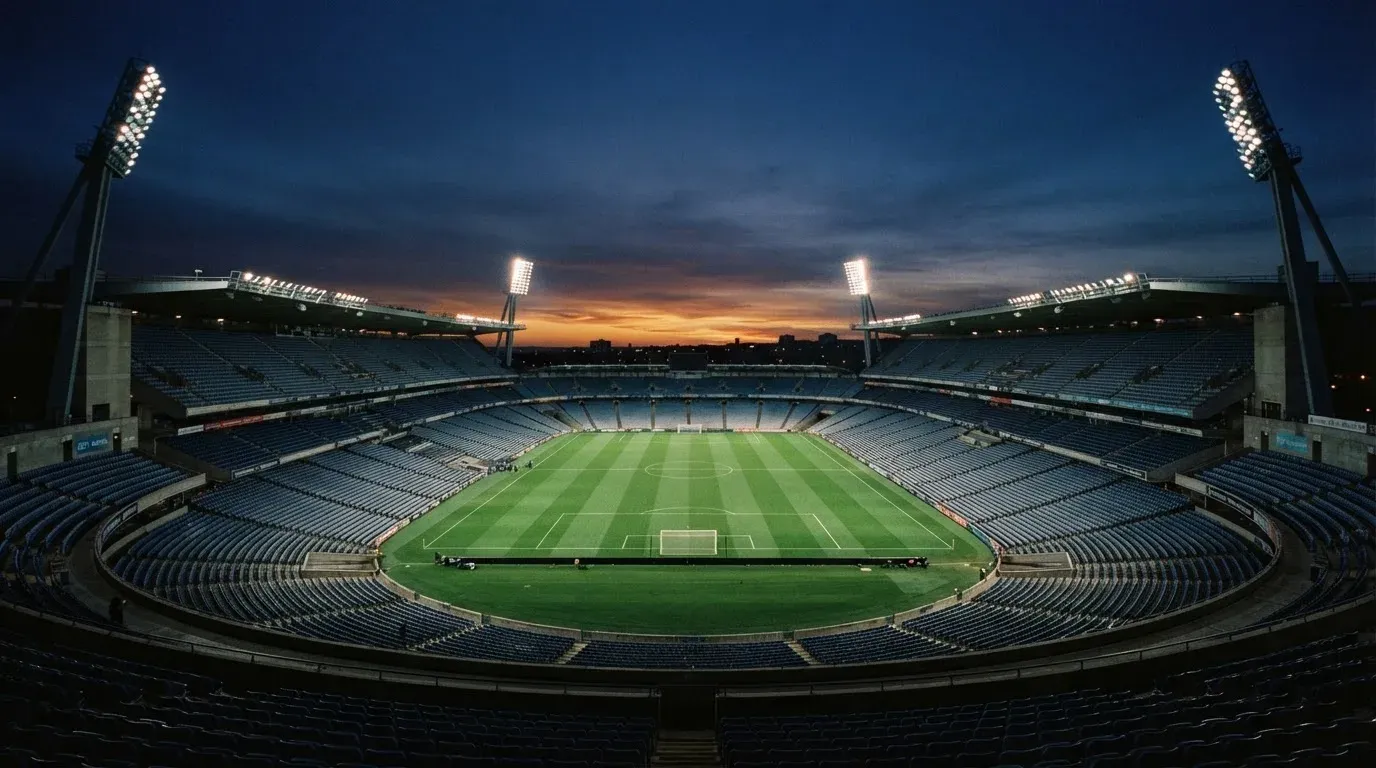
The fixture itself is, in its laws, more fixed than punters tend to remember. The Laws of the Game of association football have been maintained by the International Football Association Board (IFAB) since 1886. A standard adult match is two halves of 45 minutes each, with stoppage time added at the referee’s discretion. Each side has a maximum of eleven players on the pitch including the goalkeeper. The goal is 7.32 metres wide and 2.44 metres high. A tied match may go to extra time of two further 15-minute periods, and some competitions then use a penalty shoot-out. None of that is minutiae — each rule is a settlement rule, and a punter reading the small print on a Same Game Multi is reading those same laws back at themselves. A bet on Total Goals Over 2.5 settles at the final whistle in normal time unless the bet slip says extra time and penalties count. A bet on a player to score first settles against the scorer’s name, not against any retrospective reassignment by the governing body of the competition.
What this section is really saying: before a price is read, the event has to be understood as the bookmaker has to settle it. The punter who reads the Laws of the Game for the competition they intend to back does not need a crystal ball — they have understood the betting slip before they have placed a cent on it.
The price behind the price: how a bookmaker’s margin hides in plain sight
Three numbers appear on a 1X2 match-result market: home win, draw, away win. For a mid-table English Premier League fixture in 2026, the page uses an illustrative set of decimal odds: 2.10 / 3.40 / 3.60. Those are example prices, not quotes — TAB NZ’s actual prices on the fixture will differ. They illustrate the principle cleanly enough.

Take the three decimal odds and invert each: 1 ÷ 2.10 = 0.4762, 1 ÷ 3.40 = 0.2941, 1 ÷ 3.60 = 0.2778. Sum the three: 1.0481. Invert the sum: 1 ÷ 1.0481 = 0.9541. That final figure is the bookmaker’s payout share — the share of every dollar bet on this market that comes back to punters across all outcomes combined. The complement is the margin: 1 − 0.9541 = 0.0459, or about 4.6%.
That is what the bookmaker keeps of every $1 staked on this market, on average across all three outcomes. State the condition plainly: only on this market, on this set of prices, on this snapshot. Move one price — even one decimal place — and the margin moves with it. The 2.10 / 3.40 / 3.60 example sits in a band the page describes as roughly 4–6% for a competitive adult men’s fixture on the 1X2 market at a sharp book, with handicaps and totals typically carrying a slightly higher margin because the prices are tighter together. That band is the football punter’s working knowledge of what the bookmaker keeps.
The practical shape of this: a market at a 4.6% margin hands a punt of $10 a return of $10 × 2.10 = $21.00 if the home side wins outright, $34.00 on a draw, $36.00 on the away win. The math of one winning bet is straightforward — what the margin hides is in the joint behaviour of all three prices. If only favourites ever won at the prices quoted, the bookmaker is likely to lose; the margin is what stops that happening across thousands of bets. Every punter who picks the favourite at 2.10 pays for the punt on the 3.60 outsider that nobody took.
A useful working figure is the converse. A market with a 95.4% payout share pays back 95.4 cents in the dollar, on average across all outcomes. A market with a 90% payout share pays back 90 cents. A market with a 95% payout share and a market with a 5% margin name the same number from two sides — write the one research gives, with research’s own label. The page does not say “5% margin” where the source gives “95% payout”, and the other way around.
Markets a single football fixture opens up
The 1X2 match-result market is the entry point. The markets around it are where the bulk of football betting volume actually sits, and they settle differently.
A handicap market gives one side a goal start, written as a line — Team A −1, Team B +1. The handicap is applied to the final score before settlement; a −1 favourite has to win by two or more for the bet to land at full odds, and a +1 underdog wins if they draw or win outright. Handicap betting is the route most sharp punters take when one side is a heavy favourite, because the price on the 1X2 home win offers nothing for the risk.
A total goals market — Over/Under 2.5 is the most common — settles on the aggregate score. Over 2.5 pays if three or more goals are scored, Under 2.5 pays if two or fewer. The half-line variants, Over 1.5 and Under 3.5, settle on whole-number thresholds; Over/Under 0.5 is a win-everyone-or-lose-everyone market that essentially turns the bet into “will the match have goals”.
A Both Teams to Score (BTTS) market is binary. Both sides score at least once and BTTS Yes pays; either side fails to score and BTTS No pays. A clean sheet for either side settles BTTS No.
A correct score market names the exact scoreline. Punters are paid longer odds for the less likely outcomes — 0–0 pays more than 1–1, 1–0 to the favourite pays less than 2–1. Margins on correct-score markets are wider because the prices are spread across more outcomes. A bookmaker offering fifteen possible scorelines has to balance each one, and the implied probability sums to less than 100% of stake, leaving the margin exposed.
A same-game multi is a multi bet whose legs all come from one fixture. A punter might combine Over 2.5 goals, BTTS Yes, and a particular player to score. Each leg’s odds multiply; the price becomes the product of the three individual prices. A 1.70, 1.85, 2.40 same-game multi reads 1.70 × 1.85 × 2.40 = 7.54 — and three legs each at 70–80% implied probability do not multiply to 70–80%, they multiply to about 35–40%. Same-game multis look like the friendly version of an accumulator because they are reading probabilities that are correlated rather than independent. The bookmaker knows this; the margin knows it; the marketing knows it; the punt is on whether you do.
An accumulator is the same multiplication across fixtures that are not the same match. Four legs at 1.50 each — a price a punter meets on heavy favourites — multiply to 1.50⁴ = 5.06. The implied probability of a 1.50 leg winning is 66.7%; the implied probability of all four winning is 0.667⁴ = 19.8%, or about one in five. A successful $10 accumulator returns $50.60; a near miss on the final leg returns zero.
Spread betting is a different beast and not the same product as a handicap. A spread-bet stake is multiplied by the size of the margin by which a measured outcome beats or misses a quoted range. If a bookmaker quotes “total goals 2.6–2.8” and the final tally lands at 2.8 goals, a $10 spread bet at 2.6 returns $10 × (2.8 − 2.6) = $2.00. If the tally overshoots to 4 goals, the same stake returns $10 × (4.0 − 2.6) = $14.00. The winnings are not fixed by the price; they are fixed by where the event actually lands relative to the spread. Section 74AAA of the Racing Industry Act 2020 covers sports betting as a category — spread betting on a football match falls inside that, and there is no law that lets a New Zealand punter reach a spread book at TAB NZ or Betcha on a single football fixture. The spread product is an offshore product in this market. No lawful New Zealand betting exchange exists either; the article does not write a sentence about a New Zealand exchange.
How a weekend fixture list turns into a betting card
A punter’s working week on football starts with the schedule. Saturday’s fixtures are the heavyweight day in European football, with the Premier League, the Championship, the Bundesliga, Serie A, La Liga and Ligue 1 all running simultaneously. Sunday carries the late European matches, the morning A-League fixtures, and the late MLS games, which look like Sunday-night fare to a New Zealand reader because the time zone difference pushes each kick-off into the small hours of Monday morning local time. Midweek brings the Champions League and the domestic cups.
Each match is an opportunity: a 1X2 selection, a handicap, a total goals bet, a player-prop. Each fixture has a price the bookmaker sets, a market group, and a settlement rule. The punter who picks one selection across multiple fixtures builds a multi; the punter who picks several selections on one fixture builds a same-game multi. The punter who backs a player to score is backing a market whose settlement depends on the official match statistics the governing body of the competition publishes — not the live broadcast, not the punter’s own eyes.
Behind every coupon is the bookmaker’s risk. A bookmaker that takes $10,000 on Team A at 2.10 and $3,500 on Team B at 3.60 has built a position that depends on the draw settling at a 3.40 price on a third $1,000 of handle. The market’s job is to balance, and the punter’s job is to spot when the balance tips.
Predictions, systems and the honest shape of football analysis
“Best football bets today” returns thousands of pages of tips, previews and predictions. The honest reading of what those pages offer runs in three layers.
The first layer is fixtures and squad news. A prediction page that does not know which side is missing three first-choice defenders and is playing on 48 hours’ rest is guessing. The Premier League squads in 2026–27, the Ligue 1 promotion contenders, the Bundesliga mid-table squeeze — none of it is a mystery, and none of it can be predicted; it can be reported.
The second layer is the league’s patterns. Some leagues score more than others. Some leagues concede more late goals than others. Some leagues are settled by early leads more often than others. The English Championship has, on the historical record, a higher average goals-per-game than the Italian Serie A; the Bundesliga has more late goals than the Spanish La Liga. A punter reading the league for the shape of its scoring habits has done better work than a punter reading a tipster’s daily picks.
The third layer is the one that is honestly uncomfortable. No prediction page can name a winner ahead of kick-off with any edge a careful punter is able to depend on. The bookmaker’s margin is the universal explanation of why: every price contains a built-in deduction, and that deduction is what makes the bookmaker’s job possible. If a tipster is able to see winners ahead of time at a rate higher than the prices implied, the bookmaker is expected to change the prices until the tipster is unable. The market self-corrects, in a slow, imperfect way, but it self-corrects.
The honest shape, then: a punter uses prediction material as one input among several — the squad news, the form, the head-to-head, the price, the line on the handicap. A “best football betting system” is the answer that nobody can give, because the answer turns on discipline and bankroll management rather than on a secret formula. The systems that look best at the end of a season are the ones whose tipsters cut the losing weeks out of the public record.
Saturday football and the wider football calendar
“Saturday football” in the English Premier League is the platform that drove football betting into the mainstream in the 1990s, and it is still the day of the week on which a New Zealand punter’s weekend card is laid down. The Championship runs alongside it. Sunday brings the late European match. Monday and Friday carry the standalone fixtures that bookmakers build their promotional cards around. Tuesday and Wednesday are reserved for European competitions and domestic cup ties in midweek. Thursday brings the Europa League and the Conference League as the European weeks demand.
Australia’s A-League runs a winter calendar from October to May, with finals in late May and the grand final in early June. The OFC Champions League runs from late winter through spring, with the group stage spread across the spring and the knockout stage reaching a final in late spring. New Zealand’s domestic National League runs a smaller fixture set across late summer, with the league phase and the championships crowning a winner in late autumn. None of these calendars confuses the betting rules — each one settles under IFAB’s Laws of the Game — but each competition’s tournament rules may add or adjust how the market works: extra time does or does not count, penalty shoot-outs do or do not settle player props, abandoned matches are voided or settled by the score at abandonment.
The 2026 FIFA World Cup is a closed chapter; the 2030 edition sits at the planning stage. The 2026–27 UEFA Champions League began its league phase in mid-September and runs through to the final in late May 2027, with the new Swiss-system format from the 2024–25 season carrying forward. The 2026 AFC Asian Cup, the 2025 AFCON, the 2026 CONCACAF Gold Cup, the 2025 Rugby World Cup — a punter’s calendar across codes is now a single piece of the bet, and each competition runs against its own match calendar rather than alongside the Premier League’s. Where the punter lives and watches the game determines whether the 3 p.m. Saturday kick-off means the tea-time card or the Monday-morning card.
Reading the betting landscape in 2026
The betting landscape in 2026 is not the open market the international reader anticipates. Section 74AAA of the Racing Industry Act 2020 — in force since 28 June 2025, inserted by the Racing Industry Amendment Act 2025 — prohibits any person other than TAB NZ from offering racing betting, sports betting, or other racing or sports betting to a person in New Zealand, regardless of where that person is resident or incorporated. The Department of Internal Affairs (DIA) is the regulator; it oversees compliance with section 92A of the same Act. There is no licence register for bookmakers because there is only one lawful provider, and there is no application process that might create a second.
TAB NZ operates two online brands: TAB and Betcha. Entain runs the business under a 25-year agreement signed in 2023; the partnership gives Entain a 50/50 share of gross profits, with at least $150 million a year flowing to TAB NZ for the first five years, and a one-off $100 million payment to the racing sector. TAB and Betcha are one operator group, never rivals. They run on the same betting engine, with the same sports and racing catalogue, the same fixed-odds pricing for the same fixtures, the same rules and the same player-protection framework.
The brands a New Zealand punter meets outside New Zealand — Thunderpick, Winz, Rooster, Roobet, RoyalistPlay, Glorion, BillyBets and BetNinja among them — all sit outside the section 74AAA framework. Each carries an offshore licence from Curaçao, Anjouan, Tobique, the Union of the Comoros or simply no licence that applies in New Zealand at all. None of them gives the operator the right to take bets from people in New Zealand. New Zealand does not block these websites — the law does not work by geo-blocking — but the law puts the liability on the operator, not the player. Section 19(4) of the Gambling Act 2003 (inserted in 2025) says an individual may not be convicted for placing a bet with an offshore operator in breach of section 74AAA; no published penalty for the player was found.
The DIA warning, plainly: an overseas operator may be in a jurisdiction with minimal consumer safeguards, may not return unspent credits, may not pay out large wins, and carries no New Zealand complaints route. The point sits behind the rest of this article: the brands below are described for what they offer, not as options a New Zealand punter is advised to take.
What the law says a player must do
A punt at TAB NZ requires an account with a verified New Zealand address and ID. The age is 18; betting under 18 is an offence under section 89 of the Racing Industry Act 2020. A land-based casino’s age of 20 is a different matter under a different regime and never blurs with TAB NZ’s age rule. The 2026 Online Casino Gambling Act licenses online casino gambling only, and a TAB New Zealand casino licence does not extend the betting monopoly.
What may be bet on at TAB NZ is set out on TAB NZ’s own betting rules. The published types include Win, Place, Each Way, Quinella, Exacta, Trifecta, First Four, Double, Treble, Daily Double, Running Double, Quaddie, Big6, Multis, and Same Game Multis. Fixed-odds and tote bets are both on the menu. The Betcha brand carries the same catalogue with the same types under a wrapper app published by Entain New Zealand Limited, first released on the New Zealand App Store on 6 August 2024.
Player-protection tooling is built into the TAB NZ apps. Deposit limits, time-outs and self-exclusion sit under the account settings; an exclusion applies across both TAB NZ brands. The free Gambling Helpline is 0800 654 655, with a text line at 8006. Safer Gambling Aotearoa is the same network’s public face. Help is reachable from inside the app without leaving it.
What may be bet on and what is missing
The list of “may be bet on” and the list of “may not” is not a comprehensive answer. Bets on politics are not established. Novelty markets — on TV shows, on awards ceremonies, on elections — are not established as a TAB NZ product. The market list comes from TAB NZ’s own terms, and any update to that list happens operator-side without a legislative change behind it. Bets on the Melbourne Cup and on the major racedays of the New Zealand racing calendar are settled on TAB NZ’s own rules, including the trifecta and First4 types that are specific to racing rather than to football.
Football betting is the side of the catalogue this page is built around. Football fixtures from the Premier League, the Championship, the Bundesliga, the Champions League, the Europa League, the A-League and the OFC Champions League sit on the card. The 2026 World Cup fixture list is live as archived data. The 2026–27 Premier League runs from 21 August 2026 to 30 May 2027. Rugby union, rugby league, cricket, NBA, NFL, MMA/UFC, motorsports, esports and the racing codes carry alongside football on Betcha. Greyhound racing is closing in stages from 1 August 2026, and from that date offshore operators may not take bets on greyhound races either. The drop is racing-side rather than football-side, but a punter keeping the catalogue up to date is advised to notice it.
Bonuses and free bets at the lawful end of the market
TAB NZ runs “bonus bets” promotions. The form they take is set on the operator’s own terms; the page does not print a working bonus code or a sign-up link, and the size and the terms of any promotion are read off the operator’s own promo page at the moment the punter is considering the bet. What the page can say plainly is what a “bonus bet” really is, because the marketing of bonus bets is the same the world over and the maths does not change with the brand.
A bonus bet whose stake is not returned with a winning payout is a free bet whose expected value is bounded. Take a $10 bonus bet, a $2.10 price and a market at a 4.6% margin (95.4% payout share). The expected value of the bet is $10 × (2.10 − 1) ÷ 2.10 × 0.954 = $10 × 1.10 ÷ 2.10 × 0.954 = $4.99. The bonus bet is worth about $5 on average across many such bets. Win a single bet and the punter walks away with $10 × 2.10 = $21.00 minus $10 stake = $11.00 net; lose that bet and the punter is $0. The expected value across many bets is closer to $5 than to the headline $10 of the bonus face value. Headline money does not equal expected money; that is the cost the marketing of free bets never quite announces.
A bonus bet whose stake *is* returned — sometimes called a “risk-free” bet in marketing terms — is not the same. A $10 “risk-free” bet that returns the stake on a loss is a cash refund of up to $10; the wagering requirement (if any) attached to that refund is what decides whether the refund is a cash bonus or another bonus bet. The page does not describe the offer: it describes what the offer is worth on average and what the wagering terms typically cost. A bettor who reads the wagering terms first is one who keeps the value the marketing put there in the first place.
What a wagering requirement typically asks is a multiple of the bonus that has to be turned over in qualifying bets before any winnings become withdrawable. A requirement of 5× on a $100 bonus means $500 of qualifying bets; each qualifying bet has its own minimum price. The combined effect is that the bonus clears at a cost the punter pays through the book’s margin across the qualifying bets. Multiply the turnover by the margin and the expected cost is the size of the deduction; the bonus is paid out of a fund the bonus itself is paying for. State the condition plainly: every market the punter bets through to clear the bonus carries a margin that takes a slice of each qualifying bet’s payout. The bonus face value is the ceiling the punter earns; the margin across the qualifying bets is the floor the punter pays.
Offers that travel offshore — what changes at the edge of the market
Brands outside New Zealand — Thunderpick, Winz, Rooster, Roobet, RoyalistPlay, Glorion, BillyBets, BetNinja — advertise offers pitched at international readers. The page does not endorse any of them for a New Zealand audience. It describes each on the merits the operator publishes, because a comparison is what the page is built to do, and the comparison is honest only if it names both what is on offer and the absence of the New Zealand framework behind it.
BetNinja carries a casino welcome of EUR 1,000 plus 100 free spins, and a sports offer of a 100% match up to EUR 100 on the first deposit. Rooster, Winz, RoyalistPlay and the remaining brands each describe their promotions on the operator’s own pages, and each carries its own Sportsbook T&C, Bonus Terms and Conditions, and wagering requirements. A punter comparing offers across the eight offshore brands is comparing them against each other, not against TAB NZ; the framework behind each offer is not the New Zealand one.
A useful working rule for reading these offers, whatever the brand, is the same: a bonus has a face value, a wagering multiple, a qualifying-bet minimum price, and a deadline. Read all four. A 100% match up to EUR 100 is a EUR 50 headline bonus on a EUR 50 first deposit, with a 5× wagering multiple (read off the operator’s terms) — that is EUR 250 of qualifying bets at minimum price 1.50 (or whatever the operator’s minimum is). The required turnover is the multiple; the number of qualifying bets is turnover ÷ stake per bet; only bets at or above the minimum price count. What clearing the offer costs on average is the turnover × the margin of the qualifying market. The mechanism is identical across brands; only the numbers change.
Live betting in a single-provider market
Live betting is on the TAB NZ apps. The category is a real product: markets settle throughout a match, in-play prices adjust on goals, red cards, substitutions and the broader run of play. Any statutory restriction on in-play markets is not established, so what is offered depends on TAB NZ’s own terms.
The shape of a live market is the same as a pre-match market with a moving price. A 1X2 book that opens 2.10 / 3.40 / 3.60 before kick-off will move to 1.50 / 4.00 / 6.00 once the home side scores early, then to 4.00 / 3.50 / 1.80 once the away side equalises, then back to 2.50 / 3.40 / 3.20 by the 75th minute if both sides cancel out. The margin in the live market is wider than in the pre-match market; the price adjust costs the bookmaker more and the offer of an in-play price includes that adjustment in the spread. The implied payout share is usually 88–92% on the bigger in-play markets and below 80% on the smaller ones.
Cash out — settling a pre-match bet early at a price the bookmaker quotes mid-match — is part of the live product. TAB NZ’s product description does not commit to a cash-out feature as a guaranteed service on every market; the absence of any specific rule on cash out in research means the page does not state one way or the other for TAB NZ. The offshore brand Thunderpick advertises a cash-out feature in its sportsbook. Betcha’s product page lists an in-app bet experience without committing to cash out as a feature either. The honest reading is that cash out is a real product across the offshore brands and is not a committed TAB NZ feature in research.
What live betting offers at its best is the chance to read a match in motion. What it offers at its worst is the impulse bet. A punter laying a 1X2 wager two minutes after a goal because the price moved is reading the wrong signal — the price moved because of the goal, not because of what happens next. The discipline is the same offline as it is online: a live bet has the same settling rules as the pre-match version, the price is wider, and the margin is built in.
Choosing a path through the market
A punter in New Zealand has two distinct doors. The first is the lawful door: TAB and Betcha, both inside the TAB NZ group, both with New Zealand harm-minimisation tooling, both under DIA oversight, both with a complaints framework that reaches a New Zealand regulator. The second is the offshore door: every brand listed below the two TAB NZ brands, none of them lawful to take bets from a New Zealand address, all of them with an international licence of some kind and a New Zealand protection gap the regulator warns about.
The rest of this article is the comparison. Ten brands, each on the same set of criteria: the licence position in New Zealand, the football catalogue in 2026, the offer on the table, the live product, the responsible-gambling tooling, and what each one is worth to a punter who is weighing it. Where the data the operator publishes falls short, the row says so; where the data was not found, the row omits the cell rather than fill it with a guessed figure. The verdict under each operator is the page’s own — the bet the operator suits best, and where the operator leaves the punter out in the cold.
Where each operator sits on the football card in 2026
| Brand | New Zealand status | Football catalogue and operating terms |
|---|---|---|
| TAB | TAB NZ brand (TAB New Zealand) | Football, racing and 30+ other sports on the same TAB NZ engine; fixed odds and Multis across the Premier League, the Championship and the international calendars |
| Betcha | TAB NZ brand (TAB New Zealand) | Football alongside rugby, NRL, NBA, NFL and racing, published under Entain NZ since 6 August 2024 |
| Thunderpick | Not licensed in New Zealand (Curaçao, holder Paloma Media B.V.) | Esports-first sportsbook (CS2, League of Legends, Dota 2, Valorant); football markets from the Champions League to the NFL; cash-out feature on the sportsbook |
| Winz | Not licensed in New Zealand (Anjouan and Tobique, holder Novatrix SRL) | Sports betting bonus promotion with a separate Sportsbook T&C, Sports Rules and Bonus Terms and Conditions |
| Rooster | Not licensed in New Zealand (Tobique Gaming Commission, holder Novatrix SRL) | Live, Sports Promotions, Results, Schedule, E-sports and Predictions sections; odds in six formats |
| Roobet | Not licensed in New Zealand (Curaçao, holder Raw Entertainment B.V.) | Soccer, basketball, tennis, Counter-Strike, FIFA, baseball, ice hockey, MMA and table tennis; 18+ only |
| RoyalistPlay | Not licensed in New Zealand (Tobique Gaming Commission, holder Novatrix SRL) | Live betting, sports promotions, results and a schedule; football, basketball, tennis, handball, ice hockey, volleyball and table tennis top the list |
| Glorion | Not licensed in New Zealand | Pre-match and live betting, virtual sports, horse racing and esports; popular, niche, indoor and outdoor sport groups, plus entertainment events |
| BillyBets | Not licensed in New Zealand | Casino and sportsbook under one account; football, tennis, table tennis, basketball, ice hockey, American football, baseball, combat sports, esports, virtual sports and live betting |
| BetNinja | Not licensed in New Zealand (Union of the Comoros) | Sports welcome of 100% match up to EUR 100 on the first deposit; casino welcome of EUR 1,000 plus 100 free spins |
The table is shaped the way the spec asked for it. What it does not carry is every operating term the comparison is built on; the law-side of each row is a one-line summary of where the brand sits relative to section 74AAA, and the third column carries the catalogue and the operator-published terms the comparison needs to make sense.
TAB — the only path that lines up with the law
TAB sits at the top because it is the path the law lays down. TAB New Zealand is the holder of the only lawful right to offer racing and sports betting to people in New Zealand; the operator runs TAB and Betcha as two brands of the same engine. The catalogue covers football from the Premier League through the Championship, the Champions League and the A-League; the betting types listed in research include Win, Place, Each Way, Quinella, Exacta, Trifecta, First Four, Double, Treble, Daily Double, Running Double, Quaddie, Big6, Multis and Same Game Multis, with fixed odds and tote options across racing and sports.
The TAB NZ app carries safer-gambling tooling in its settings: deposit limits, time-outs and self-exclusion. The Gambling Helpline at 0800 654 655 and the text line at 8006 are listed inside the app. The 17+ App Store age rating coexists with the operator’s stated rule that customers must be 18 or over to bet, and the deposit process verifies a New Zealand address before the account is paid. TAB NZ’s first app release on the New Zealand App Store was 8 September 2014; the catalogue has built on that spine for over a decade. Trackside live race streaming with in-app betting, racing form, Blackbook and Jockey Challenge tools, plus a simplified wallet for deposits and withdrawals, run alongside the sportsbook in the same wallet.
Where TAB leaves the punter out in the cold is the second-bookmaker comparison this page keeps trying to make. There is no second lawful bookmaker; there is no competitor’s sign-up offer to weigh against TAB’s; there is no rival’s in-play book to compare with TAB’s live markets. The punter who wants to price-shop on the Premier League has nowhere else lawful to shop. That is the trade-off the monopoly imposes, and TAB is the brand the law hands the choice to.
Betcha — the same engine under a second wrapper
Betcha is a wrapper brand for the same TAB NZ engine. The New Zealand App Store listing names Entain New Zealand Limited as the publisher, with a first release on 6 August 2024 — the new brand under a long-running partnership. Football sits on the catalogue alongside rugby, NRL, NBA, NFL, tennis, cricket, MMA/UFC, motorsports, esports and the racing codes.
The mechanic is what makes Betcha look different: a younger app, a modern interface, an Entain NZ stack. The substance is the same as TAB. The bonus bets the operator runs are the same bonus bets under a different label, settled against the same terms, with the same harm-minimisation tools applied because the customer is a customer of TAB NZ whichever brand they used to sign in.
Verdict: Betcha suits the punter who wants the same access on a fresh piece of software. For a punter already with a TAB account, opening Betcha is not a comparison — it is opening a second door to the same room.
Thunderpick — esports-first, with a sportsbook attached
Thunderpick calls itself crypto esports betting and casino. The sportsbook sits alongside an esports-first product covering CS2, League of Legends, Dota 2 and Valorant. Football markets run from the Champions League to the NFL on the same sportsbook; a cash-out feature is named. The Curaçao licence OGL/2024/677/0722, holder Paloma Media B.V., gives no right to take bets from people in New Zealand.
The comparison earns its place on the row because the sportsbook exists, the cash-out feature is named and the football catalogue reaches into the major European leagues. What the comparison cannot sell is the law: New Zealand framework tools do not reach this brand.
Verdict: a punter outside New Zealand has a sharp esports-plus-football mix in front of them with named cash-out. A New Zealand punter has a brand the DIA tells them carries no New Zealand complaints route and no harm-minimisation framework.
Winz — sports-betting bonus promotion with a separate book
Winz runs a sports betting bonus promotion with separate Sportsbook T&C, Sports Rules and Bonus Terms and Conditions pages. The Anjouan and Tobique licences sit under Novatrix SRL, neither of which applies in New Zealand. The structure — a dedicated sportsbook with its own promotion, its own rules, and its own wagering terms — is what the comparison rows are built to read.
Verdict: a structured offshore sportsbook with named bonus terms and a separate rules page. This offshore brand falls outside the reach of the New Zealand regulator, and carries no protection for local punters.
Rooster — Live and E-sports sections, with a Predictions tab
Rooster runs a sportsbook with Live, Sports Promotions, Results, Schedule, E-sports and Predictions sections; six odds formats are supported on the site. The Tobique e-gaming licence No. 0000002 sits under Novatrix SRL.
The point the row makes is the structure: a sportsbook with a Predictions tab is a sportsbook that mixes betting with content, and that combination is the one punters meet on most modern offshore books. Useful to a reader comparing bookmakers; useless on the New Zealand side of the comparison.
Verdict: a modern offshore sportsbook organised around its content and live product. Local punters are advised that this platform operates independently of the New Zealand framework.
Roobet — sportsbook with crypto behind it, no New Zealand licence
Roobet’s sportsbook covers soccer, basketball, tennis, Counter-Strike, FIFA, baseball, ice hockey, MMA and table tennis. The terms require players to be 18 or older. The Curaçao licence OGL/2024/687/0427 is under Raw Entertainment B.V.
The 18+ rule overlaps with TAB NZ’s 18+ rule and does not change it; the licences do not overlap. A New Zealand punter on Roobet has access to a crypto-native sportsbook with a wide catalogue; a New Zealand punter on TAB NZ has access to a sportsbook with the regulator behind it. The two are not the same offer.
Verdict: a crypto-native brand with a wide catalogue that spans soccer, esports and the US leagues. New Zealand protection is absent, and the operator’s licence is not recognised here.
RoyalistPlay — broad catalogue, Tobique licence
RoyalistPlay’s sportsbook offers live betting, sports promotions, results and a schedule. Football, basketball, tennis, handball, ice hockey, volleyball and table tennis head the catalogue, with a separate E-sports and Predictions section. The Tobique licence sits under Novatrix SRL.
The catalogue is broad enough to be useful for a football punter who wants a second screen of markets — live betting on the smaller leagues, the volleyball and handball side of the European season, the same-game multis. The licence is offshore.
Verdict: a broad-market offshore sportsbook with a separate Predictions tab and an E-sports section. Useful for a punter outside New Zealand, irrelevant to one inside.
Glorion — pre-match, live, virtual and entertainment all under one roof
Glorion carries pre-match and live betting, virtual sports, horse racing and esports. The sports pages group popular, niche, indoor and outdoor sports, with entertainment events sitting alongside them — award shows, elections and the rest. Glorion names no licence that applies in New Zealand; the operator-side framework cannot be reached from a New Zealand regulator.
The “entertainment events” line is the one point this operator goes beyond the football card: a punter comparing brands has, for the first time on this list, a brand that offers bets on politics and the awards calendar alongside football.
Verdict: a broad entertainment-and-sports book, the only one on the list to take bets on non-sporting events. A New Zealand punter weighing Glorion is weighing an entertainment product the law cannot reach.
BillyBets — casino and sportsbook under one account
BillyBets runs a casino and a sportsbook under one account. The sportsbook covers football, tennis, table tennis, basketball, ice hockey, American football, baseball, combat sports, esports, virtual sports and live betting. Glorion names no licence that applies in New Zealand.
The single-account structure is the comparison row’s point: a punter who wants casino and sports on one wallet does not have to manage two balances, and the sports catalogue runs wide enough to handle the smaller European leagues, the US leagues, the combat-sports calendar and the esports card alongside football.
Verdict: a one-wallet casino-and-sportsbook with the broadest US-and-combat catalogue of any row on the list. None of that changes the New Zealand licence position.
BetNinja — the row with a named sports welcome
BetNinja runs a sports offer of a 100% match up to EUR 100 on the first deposit, alongside a casino welcome of EUR 1,000 plus 100 free spins. The licence is from the Union of the Comoros.
The row’s distinguishing point is the welcome: the comparison now has a specific size and a specific cap to read off. The 100% match up to EUR 100 is a EUR 50 bonus on a EUR 50 first deposit; the wagering requirement is read off the operator’s terms (the page does not state it because research does not); the qualifying-bet minimum price is read off the operator’s terms for the same reason. The shape of the offer is the same as any other sportsbook welcome, and the comparison reads the offer the same way.
Verdict: a sportsbook welcome sized for the offshore betting market, named specifically enough to compare. The licence position makes the offer a non-starter for a New Zealand address.
Recomputing what the page actually says
The 4.6% margin on the illustrative 2.10 / 3.40 / 3.60 market is one figure; it sits in a band the page gives as roughly 4–6% for a competitive adult men’s fixture on the 1X2 market at a sharp book. Punters comparing prices have a working tool here: invert each price, sum the inverses, invert the sum, subtract from one. The margin moves with each price change.
The punter’s working test on any market they care about is the same: take the price TAB NZ quotes and check the margin on the implied payout. Where the margin is tight on the 1X2 of a competitive fixture, it is wider on the totals and wider still on the correct-score market. A simple rule of thumb is the closer to the bottom of the band the margin sits on a 1X2 price, the closer to the top of the band it sits on the same fixture’s correct-score price; the difference covers the book’s extra settling cost.
Frequently asked questions
How does spread betting work in football?
A spread bet is a stake multiplied by how far a number — total goals, say — ends up from a quoted range. A spread of 2.6–2.8 goals settled at the end of normal time: a $10 stake at 2.6 returns $10 × (actual − 2.6). A punter’s win or loss is not the same shape as a fixed-odds bet; the stake can grow if the result overshoots the spread by enough. Spread betting is outside TAB NZ’s sports-betting definition, so no New Zealand bookmaker offers it on a single football fixture. The punt is offshore.
How do you bet against the spread in football?
Betting against the spread in football is the standard handicap market written the other way around. The bookmaker quotes Team A −1 / Team B +1; the +1 side is “getting a goal” and “the spread bet” if the punter takes Team B plus the goal. A New Zealand punt takes this market through TAB NZ’s 1X2 with handicap markets. Bets settle on the result plus the handicap line at full-time, and extra time does not count unless the slip says so. The framing is upside-down for a reader more familiar with North American sport, but the market is the same.
How do you bet football matches correctly?
The blunt answer is that nothing in this page names who will win a fixture and nothing can: no prediction on a reader’s behalf survives contact with the kick-off. What a careful bet does is read the form, the squad news, the line, and the price; pick a market they understand; stake a share of the bank they can write off; and avoid the categories — BTTS on a clean-sheet side, total goals over the league’s average — that the price has already discounted. The discipline is the bet. The system is reading what the price is already saying.
Which bookmaker may lawfully take sports and racing bets in New Zealand?
TAB NZ. The Racing Industry Act 2020, section 74AAA, in force since 28 June 2025, prohibits any other person offering racing or sports betting to a person in New Zealand. The Department of Internal Affairs is the regulator; the brands of TAB NZ are TAB and Betcha. No other brand is licensed or lawful for New Zealand customers; offshore brands named earlier in this article are not approved.
How is the return on a bet worked out from the stake and the odds?
Return = stake × odds. A $20 stake at decimal odds 3.40 returns $68.00, with net profit = stake × (odds − 1) = $20 × 2.40 = $48.00. The same formula holds for a combination bet: the per-leg odds multiply into a single price, and the total return is the stake times that product. The bookmaker’s margin is already inside the price; the formula does not double-count it. The page uses this rule across every operator row above.
What is the bookmaker’s margin and how can it be seen in the odds?
The margin is the share of every unit staked that the bookmaker keeps across all outcomes of one market. The arithmetic is payout share = 1 ÷ (sum of the inverses of all prices) and margin = 1 − payout share. Three prices at 2.10 / 3.40 / 3.60 sum, after inversion, to 1.0481; the payout share is 1 ÷ 1.0481 = 0.9541; the margin is 1 − 0.9541, or about 4.6%. The margin is what the punter pays, on average, every time they bet through any bookmaker; the lower it is on a market, the cheaper the bet is to place.
Football – kiwiracingbets
Content created by the «kiwiracingbets» team
