Spread Betting in New Zealand in 2026: How It Works, Where It's Lawful, and What Costs the Punter
 Available in US
Data current as of October 30, 2026 and checked against the Department of Internal Affairs’ public statement on the Racing Industry Amendment Act 2025 and TAB NZ’s published terms.
Searches for “spread betting in New Zealand” run into the same brick wall from opposite directions. Punters who already know what a spread bet is want to know where to place one here, and readers who have only heard the phrase want to know how the wager type actually pays out. Both questions deserve a real answer. The honest answer is that New Zealand law treats almost every kind of spread bet as unlawful for an operator to take from someone in this country, while doing nothing to punish the player who places one offshore. That gap is the whole shape of this page.
What “Spread Betting” Actually Means
Spread betting is not a market — it is a payoff structure. Instead of staking money against a single outcome at fixed odds, the bettor chooses a level (the strike), backs a direction, and the return (or loss) is calculated by how right or wrong they turned out to be.

The mechanic, in one sentence
Profit or loss equals the stake multiplied by the number of points by which the result differs from the bet level — and losses are not capped by the stake itself. That single rule is what makes spread betting different from every wager on TAB NZ’s app. A fixed-odds win pays the stake plus a profit; a fixed-odds loss costs the stake. A spread-bet loss can cost several times the stake, because the only ceiling is the size of the wrong answer.
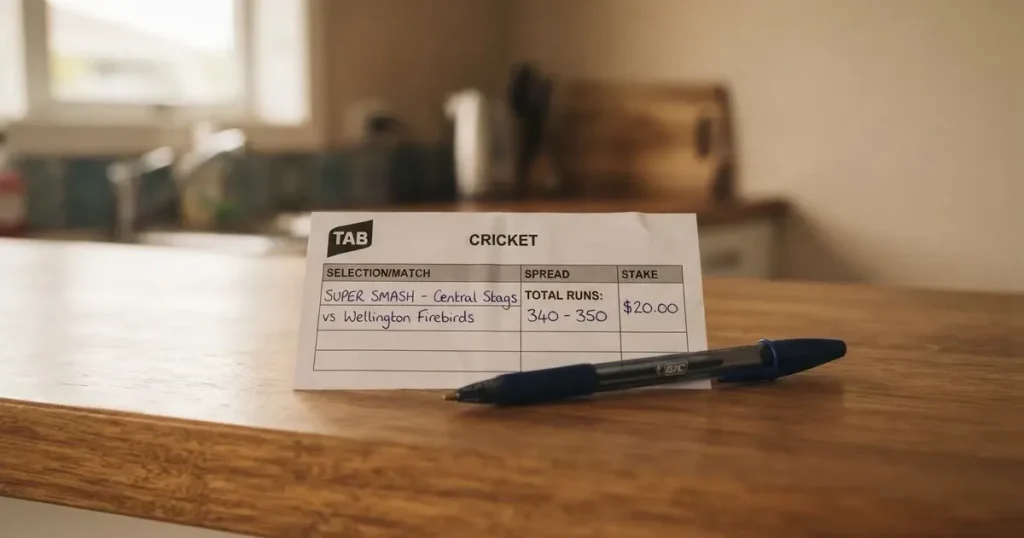
A concrete example is the cricket illustration in the wider literature. Take a quoted spread of 340–350 runs for a team’s first innings. A punter who “buys” at 350 — betting the team will total more than the top of the spread — wins 50 units multiplied by their stake per run if the team totals 400. The arithmetic is the same on both sides of the line; the loss just as real as the win.
Buying and selling the spread
In UK-style sports spread betting the bettor buys (bets that the outcome lands above the top of the spread) or sells (bets that it lands below the bottom). The trade-off between buying and selling is the spread itself, which sits between the two numbers the bookmaker quotes. A tighter spread means a smaller margin between winning and losing levels; a wider spread means more points must be cleared either way before money changes hands.
North American point-spread betting is a different creature
The phrase “betting against the spread” in North American football and basketball refers to a handicap line, not a UK-style spread. The wager pays at fixed odds, the bookmaker sets a margin around the line, and a result landing exactly on the spread is a “push” — the stake comes back. The standard price is roughly 10 to 11 (-110 in American odds), meaning a $110 outlay returns $100 of profit on a win. The word “spread” is shared; the payoff structure is not. New Zealand punters who hear about “the spread” on American television are hearing about something else from what a UK or Australian firm offers as “spread betting”.
The inventor was a Connecticut mathematics teacher turned Chicago bookmaker — Charles K. McNeil, in the 1940s.
The collateral point most punters miss
In financial spread betting — currencies, indices, commodities — collateral is typically 5–10% of total exposure, because the notional position dwarfs the stake. Losses are still uncapped. A small stake with a wildly wrong view can thus move real money. Sports spread betting sits closer to a smaller-stakes cousin of the same idea, but the same lesson applies: the magnitude of a loss is what makes this wager type different, not the direction.
The Landscape of Spread Betting in New Zealand in 2026
Consequence is the right frame for New Zealand in 2026 because the rule does the deciding for the punter long before the odds do.
A lawful spread-betting provider does not exist here
The Racing Industry Act 2020 already named TAB New Zealand as the sole betting operator for racing and sports in New Zealand. The Racing Industry Amendment Act 2025 added section 74AAA, in force since 28 June 2025, which forbids anyone other than TAB NZ from offering racing betting, sports betting or “other racing or sports betting” to a person in New Zealand — regardless of where that person is resident or incorporated. The Department of Internal Affairs told unlicensed providers serving New Zealand to withdraw with immediate effect. There is no licence register for bookmakers because there is only one lawful provider, and no licence to apply for.
The phrase “other racing or sports betting” is the one that catches spread betting. TAB NZ’s sports-betting definition covers fixed-odds and tote bets, not spread or exchange products. Spread betting sits one rung outside that definition and is consequently not something any operator other than TAB NZ may lawfully offer — and TAB NZ itself does not offer it.
TAB NZ’s two online brands
TAB and Betcha are the two online brands of TAB New Zealand and they run as one operator group. Betcha is not a rival bookmaker to TAB. The two are the same licence holder under the same statute, and an exclusion or a deposit limit set on one applies across both brands.
The running of the TAB business sits under a long-term agreement with Entain, signed in 2023: a 25-year term, a 50/50 share of gross profits, at least NZ$150 million going to TAB NZ each year for the first five years, and a one-off NZ$100 million payment Entain pledged to the racing sector. The detail matters because it explains why a competitor does not exist on the lawful side — TAB NZ’s revenue underwrites the codes the same way its exclusivity defines the market.
What offshore brands actually offer
Punters in New Zealand will meet offshore brands that name a spread-betting desk or a sportsbook structured around spreads. None of them may lawfully take a bet from someone in New Zealand. Names that appear in the international market — Rabona, Sportaza, RTbet, Telbet, 22Bet, Rooster, Spinbara, Thunderpick, RoyalistPlay, Ivibet, BillyBets — operate under licences issued in Curaçao, Anjouan, the Tobique Gaming Commission or similar overseas regimes. Those licences do not extend to people in New Zealand. A bet placed from a New Zealand address breaks New Zealand law on the operator’s side; the player’s protection, if anything goes wrong with a withdrawal, a bonus term or a voided market, comes only from the foreign regime and its complaints process.
For the reader the practical shape is this: there is one lawful route for racing and sports betting from New Zealand (TAB and Betcha), and it does not offer spread betting. Every spread bet a New Zealand resident wants to place has to go to an operator outside the local regime, with the consequences that fall out of that.
Statute, Regulator and the Tax Frame
The regulator is the Department of Internal Affairs, working under the Gambling Act 2003 and monitoring compliance with the betting prohibition in section 92A of the Racing Industry Act 2020. The Racing Industry Amendment Act 2025 inserted section 74AAA, the prohibition that does the work here.

For the player, Inland Revenue guidance treats recreational gambling winnings as generally not taxable, and prize money from TAB horse, dog and trotting races as not taxable. A person who bets as a business is a different case and must consult Inland Revenue or an accountant — that is general information, not tax advice. Operator side: TAB NZ pays a Problem Gambling Levy of 0.74%, in force from 1 July 2025 to 30 June 2028, and overseas operators supplying New Zealand residents pay online gambling duty (12% of profits since 1 July 2024, 16% from 1 January 2027). Crucially, an operator paying tax does not make its offer lawful. The point-of-consumption charge on offshore racing and sports bets ceased on 30 June 2026.
Greyhound racing is closing in stages from 1 August 2026, and from that date an offshore operator may not take bets on greyhound races here either.
Safer Gambling in the Monopoly
Because only TAB NZ may lawfully offer betting to people in New Zealand, all the harm-minimisation tools that exist for online betting here sit inside TAB NZ and Betcha. TAB NZ’s app lists deposit limits, time-outs and self-exclusion; a self-exclusion applies across both brands. The free Gambling Helpline is 0800 654 655, with a text line at 8006, and Safer Gambling Aotearoa provides counselling and support.
The age for TAB NZ betting is 18. Land-based casinos are 20 — never conflate the two. Account opening at TAB NZ requires a verified New Zealand address and ID, which is also why every offshore account that lets a New Zealand punter deposit and bet without those checks is, on the operator’s side, breaking the prohibition.
A national self-exclusion register for online casinos will exist under the 2026 law, but it covers casinos only, not betting. The Department of Internal Affairs’ own warning to offshore players runs the same way it runs in every comparable jurisdiction: an overseas operator may be in a country with minimal consumer safeguards, may not return unspent credits, and may not pay out large wins. New Zealand law does not geo-block offshore sites — it puts the liability on the operator, and the consequence on the punter is whatever that operator decides in the small print.
How a Spread Bet Settles: Selection, Stake, Settlement
Spread betting punts on three numbers the punter chooses, and one number the result delivers.
Picking the market
A spread-betting firm quotes a range — a top number and a bottom number — for a given outcome on a fixture or a financial instrument. Cricket team totals, football goal ranges, rugby point bands, indices, currency pairs and commodity levels all have bookmakers who publish a spread. The market is whatever the firm publishes, and the punt is whatever number in that range the bettor chooses to back.
Picking the direction and strike
The punter decides whether to buy (back above the spread) or sell (back below it) and picks a number inside or beyond the quoted range. Buying at 350 on a cricket spread of 340–350 means the strike is 350; selling at 340 means the strike is 340.
Staking per unit
The punter stakes an amount per unit (per run, per goal, per index point, per pip). A stake of $1 per run on a cricket innings that finishes 100 runs away from the strike produces $100 profit or $100 loss, multiplied by the unit stake.
Settling when the result lands
Settlement is the absolute difference between the result and the strike, multiplied by the unit stake, applied to the direction the punter took. Cricket example with a spread of 340–350: buying at 350 on a 400-run innings pays 50 × unit stake; the same position on a 300-run innings costs 50 × unit stake. There is no cap on the loss other than the size of the wrong answer.
That last point repeats for a reason. A punter who walks into a spread bet expecting a max loss equal to the stake has the wrong wager in front of them. The mechanic is not a bug — it is the whole wager type.
Sports and Tournaments That Move Spread Markets
Spread firms price the markets punters watch most, which tends to track what a betting public pays most attention to.
Cricket
Cricket’s total-runs markets are the textbook illustration. Spread firms publish a band around an expected team innings total, and punters buy or sell on that band. The wickets-fallen and individual-runs markets exist too, but team innings totals are where the wager type reads cleanly.
Football
Football spread markets include total-goals ranges, corners, bookings, time of first goal and player-specific markets. North American point-spread betting on the Super Bowl and college football uses the handicap line with a push on the exact number — a different payoff structure, even though the word “spread” is shared. The two are read as separate products.
Basketball and the US leagues
Basketball points spreads in the North American style are widely covered, with margins around the handicap. The standard price in that market sits at -110 (10 to 11): a $110 outlay returns $100 of profit on a win, which is the bookmaker’s margin baked into the price.
Rugby, racing and others
Rugby union, rugby league and rugby sevens have spread coverage on total points, handicaps and player markets. Horse racing has spread totals on winning margins and race times where a spread firm is publishing. Greyhound racing closes in stages from 1 August 2026, at which point it drops out of every spread book on the lawful side and out of offshore books for a New Zealand-resident bettor.
Financial and crypto
Financial spread betting covers indices, FX pairs, commodities and crypto. Those markets run on collateral of 5–10% of total exposure; losses are still uncapped, which is why the firms offering them ask new accounts to use a demo account before sizing up.
A Margin, in Plain Numbers
The bookmaker’s margin is the share of every dollar staked that the book keeps, on average, across the outcomes of a single market. It is the leakage a punter pays for every bet placed, and the only honest way to compare two sets of odds.
For a two-way market with decimal odds of 1.90 against either outcome, the payout share per dollar staked is 1 ÷ (1/1.90 + 1/1.90) = 1 ÷ (2/1.90) = 1.90/2 = 0.95, or 95%. The margin is the remaining 5% — the cut the book keeps from a market at fair prices. Where the margins shrink — closer to 2–3% on major-favourite totals in liquid markets — the punter leakage falls. Where they widen — to 8% or more on minor-league markets or exotic markets — the punter leakage rises. Two headline prices that look similar can mask wildly different margins depending on the market, the fixture and the firm.
The qualifying band for a two-way market at 1.90 against each selection is thus 5% margin at an even price — that is the floor, not the ceiling. Other markets on the same fixture can sit at a higher margin without the headline price moving much; a point-spread at 1.91/1.91 is a thinner 4.5% margin, and a totals line at 1.85/1.85 widens that to roughly 7.5%. The band, not a single number, is the right framing — markets where the prices are published carry their own margin, and a 5% margin at 1.90 is the clean illustration of what the formula does.
This is also the test for any “best odds” claim a spread firm makes on its own banner. The margin on the markets that banner pull-quote from is the only check that matters.
The Two Lawful Brands and Eight Offshore Names, Compared
This comparison puts TAB NZ’s two online brands first, then offshore brands that punters in New Zealand will encounter, on the same yardsticks. The first two are lawful; the others are not. The yardsticks are not endorsements.
| Brand | New Zealand status | What the operator’s own terms state on spread betting |
|---|---|---|
| TAB | One of the two online brands of TAB NZ; the only provider lawfully offering racing and sports betting to people in New Zealand under section 74AAA of the Racing Industry Act 2020 (in force 28 June 2025); no spread-betting product is published in TAB’s own terms. | TAB NZ takes fixed-odds and tote bets (Win, Place, Each Way, Quinella, Exacta, Trifecta, First Four, Double, Treble, Quaddie, Big6, Multis, Same Game Multis); spread and exchange betting sit outside TAB NZ’s sports-betting definition. |
| Betcha | One of the two online brands of TAB NZ; same lawful status as TAB under section 74AAA; not a rival bookmaker. | Betcha’s app surfaces a daily Toolbox of odds boosts and insurance for unsettled bets, a Bet Social feed for punters to chat and share pools, and a Playbook with tips and match analysis. No spread-betting product. |
| Rabona | Not licensed in New Zealand; the brand operates from a Curaçao licence under Soft2Bet, with no right to take bets from people in New Zealand. | Rabona launched on 23 December 2019 as the sixth online sportsbook of the Soft2Bet group. No New Zealand complaints route or harm-minimisation framework. |
| Sportaza | Not licensed in New Zealand; the brand names an Anjouan licence, with no right to take bets from people in New Zealand. | Sportaza’s terms publish cash out, Bet Builder (a void leg voids the slip), multiples, Asian lines and 1/5/10/15-minute interval markets. No New Zealand complaints route. |
| RTbet | Not licensed in New Zealand; the brand names a Curaçao licence, with no right to take bets from people in New Zealand. | RTbet’s terms publish cash out before an event or market is settled, fix the cash-out amount at the moment it is accepted, and say the feature may not always be available. No New Zealand complaints route. |
| Telbet | Not licensed in New Zealand; the brand names no licence that applies in New Zealand. | Telbet describes itself as a crypto casino and sportsbook; its own offers reference crypto-denominated bonuses and free bets. No New Zealand complaints route. |
| 22Bet | Not licensed in New Zealand; the brand names a Curaçao licence (8048/JAZ) under TechSolutions Group N.V., with no right to take bets from people in New Zealand. | 22Bet’s published line takes singles, accumulators, systems and chains, with live betting at real-time odds and score updates. No New Zealand complaints route. |
| Rooster | Not licensed in New Zealand; the brand names a Tobique Gaming Commission e-gaming licence (No. 0000002) under Novatrix SRL, with no right to take bets from people in New Zealand. | Rooster’s terms are published by a Costa Rica–incorporated operator (Novatrix SRL, registration 3-102-893958). No New Zealand complaints route. |
| Spinbara | Not licensed in New Zealand; the brand names no licence that applies in New Zealand. | Spinbara publishes a first-deposit bonus of 100% up to EUR 100, a sport crypto welcome of 100% up to 200 USDT, and a casino welcome of 100% up to EUR 500 plus 200 free spins. No New Zealand complaints route. |
| Thunderpick | Not licensed in New Zealand; the brand names a Curaçao licence (OGL/2024/677/0722) under Paloma Media B.V., with no right to take bets from people in New Zealand. | Thunderpick positions itself as a crypto esports betting and casino product. No New Zealand complaints route. |
TAB
TAB NZ’s app, “TAB — Racing & Sports Betting”, has been on the New Zealand App Store since 8 September 2014 under the seller name New Zealand Racing Board. The product covers thoroughbred, harness and greyhound racing (the greyhound codes closing from 1 August 2026) along with sports betting — fixed-odds and tote formats, with Win, Place, Each Way, Quinella, Exacta, Trifecta, First4, Double, Treble, Quaddie, Big6, Multis and Same Game Multis as the published bet types. A live betting menu sits inside the app; whether any statutory restriction on in-play markets exists has not been established.
The verdict: TAB NZ is the only lawful option for sports and racing betting in New Zealand, full stop — but its product set is fixed-odds and tote, not spread. A punter who wants the spread wager type has moved past TAB by definition.
Betcha
Betcha is the second TAB NZ brand, run under the same section 74AAA licence and the same harm-minimisation obligations. Its product on the New Zealand App Store lists a daily Toolbox with odds boosts and insurance tools for bets that do not land, a Bet Social section for punters to chat, follow tipsters and share bets or pools, and a Playbook with tips and match analysis. Same Game Multis and live betting are visible from the sportsbook. No spread product.
The verdict: Betcha exists for the same audience TAB does, plus a younger bettor drawn to the social feed and the boosted-odds daily drop. Same lawful status, same absence of spread markets.
Rabona
Rabona launched on 23 December 2019 as the sixth sportsbook from the Soft2Bet group. Its licence is Curaçao, with no applicability to New Zealand residents. The product is a typical European-style sportsbook — pre-match and live, with a casino section attached.
The verdict: a serviceable European sportsbook outside New Zealand’s frame, lacking any legal standing to take a New Zealand bet. The spread-betting modules some Soft2Bet brands ship are not Rabona’s headline product, and any spread exposure on this brand comes as part of a wider sportsbook with no New Zealand regulatory backstop.
Sportaza
Sportaza’s terms publish cash out (taken before settlement), Bet Builder with the rule that one void leg voids the slip, multiples, Asian lines and 1/5/10/15-minute interval markets. It is an Anjouan-licensed brand with no New Zealand standing.
The verdict: a strong in-play product with the kind of granular interval markets a serious live bettor wants. The Bet Builder rule and the absence of a New Zealand complaints route both cost a New Zealand-based punter more than the product surfaces — particularly when markets settle outside the spread the book was quoting.
RTbet
RTbet’s terms publish cash out before settlement, with the cash-out figure fixed at the moment the punter accepts it and a warning that the feature may not always be available. Curaçao-licensed; same offshore framing for New Zealand.
The verdict: the explicit “this feature is not always available” line in the terms is the more honest disclosure than most peers. Punters who want a fixed cash-out number at the moment of acceptance must read it as a feature, not a guarantee.
Telbet
Telbet describes itself as a crypto casino and sportsbook; the published welcome references BTC-denominated bonuses and free bets in USDT. No licence applicable to New Zealand.
The verdict: a crypto-first sportsbook that does not pretend to be anything else. The crypto framing cuts both ways: deposits and withdrawals are friction-free for a punt-sized bet, but the same friction-free flow is also why no New Zealand regulator can review a complaint.
22Bet
22Bet’s published line takes singles, accumulators, systems and chains, with live betting at real-time odds and score updates. Curaçao-licensed under TechSolutions Group N.V. (8048/JAZ).
The verdict: a deep market depth and the widest range of bet types among the offshore names on this list. The Curaçao frame is identical to the brand’s peers, but the volume of markets on a Tuesday in the European football lower divisions is the practical advantage.
Rooster
Rooster is operated by Novatrix SRL, a Costa Rica–incorporated company (registration 3-102-893958) under a Tobique Gaming Commission e-gaming licence (No. 0000002). The terms state the corporate arrangement.
The verdict: a newer framing of an offshore sportsbook. The Tobique licence is recent, the Costa Rica corporate structure is the actual operating shell, and a New Zealand punter’s recourse is whichever regime answers the Tobique commission on a complaint.
Spinbara
Spinbara’s site publishes a first-deposit bonus of 100% up to EUR 100, a sport crypto welcome of 100% up to 200 USDT and a casino welcome of 100% up to EUR 500 plus 200 free spins. No licence applicable to New Zealand.
The verdict: the bonus ladder is the brand’s main sell. Three welcome tiers across sport and casino with separate terms; a punter who claims one bonus stack at a time reads the wagering factors and minimum prices for that bonus before staking.
Thunderpick
Thunderpick is owned by Paloma Media B.V. (Curaçao, company number 146988) and operates under Curaçao licence OGL/2024/677/0722. The brand positions itself as a crypto esports betting and casino product.
The verdict: an esports-first sportsbook for a punter whose interest is competitive video gaming first and sport second. The Curaçao frame is the same as the rest, but the thin pre-match sports menu is the trade-off for the esports focus.
How a Spread Bet Actually Plays Out: A Walkthrough
A walkthrough is the right shape for a section on how spread betting works because the mechanic depends on every step landing.
The punter opens a demo account at a UK-style spread firm that does not accept New Zealand residents, registers with personal details and an address outside New Zealand, and tops up the account with the firm’s required collateral — typically 5–10% of the intended exposure. They pick the cricket spread quoted by the firm (say 340–350 runs), choose to buy at 350, and stake $1 per run. If the innings finishes at 400, the punter wins 50 × $1 = $50 in profit. If it finishes at 300, the punter loses 50 × $1 = $50. If it finishes at 320, the loss is 30 × $1 = $30. The minimum loss on the wrong side of 350 is zero (if the team finishes exactly at 350); the maximum loss is whatever the team scores below, scaled to the stake per run.
The same mechanic in financial markets works on indices, currencies and commodities. A punter buys the FTSE at 7,500 with a $1 per point stake and the index closes at 7,550: profit of 50 × $1. The index closes at 7,400: loss of 100 × $1. The collateral posted at the start is the deposit that absorbs interim losses, not the maximum possible loss.
A New Zealand punter facing this product, though, walks past the same brick wall the rest of the page describes. The lawful route stops at fixed-odds and tote. The offshore route requires an account not registered in New Zealand and accepts the consequences of section 74AAA on the operator’s side.
Reading the Odds When There Is No Spread
For a punter who ends up on TAB NZ or Betcha, the relevant wager types are fixed-odds and tote — and the way to read them follows the same logic.
A fixed-odds single at decimal odds of 3.50 with a $10 stake pays $35 if it wins (the original $10 stake plus a $25 profit) and loses the $10 stake if it does not. The bookmaker’s margin on that single-outcome market has to be read from the other side of the line, because a single price is just that one price — the margin sits in how far it is from a “fair” 1 ÷ (probability the bookmaker estimates). The tote (pool) works differently: the dividend is the final payout after the tote takes its cut, divided by the number of winning units staked, and the payouts are not declared until after the race.
The North American handicap line carries its own margin. At -110 (1.91 in decimal odds) against either side of a handicap, the punter pays about 4.5% margin each time, baked into the price. A line at -105 (1.95) tightens the margin; a line at -115 (1.87) widens it. The headline handicap moves; the margin moves with it.
The lesson is the same one the spread-bet section above carries: the price is not the only number on the slip, and the second number is the one a serious punter watches.
Frequently Asked Questions
Does spread betting work the same way in football as in cricket?
Yes — the mechanic is identical. Profit or loss equals the stake per unit multiplied by the absolute difference between the result and the bet level, applied to the direction the punter took. Football markets are typically priced on total-goal ranges, corners or bookings, while cricket spread markets are usually priced on team innings totals — but the arithmetic on either side of the strike is the same, and losses are uncapped on both.
What does “betting against the spread” mean?
Two different things, depending on the country. In North American football and basketball, “betting against the spread” means taking the points on a handicap — picking the underdog with a line attached, at fixed odds (commonly -110, or 1.91 in decimal). In UK-style sports spread betting, “against the spread” describes a sell position — betting below the bottom of the published range. The first pays a fixed margin at fixed odds; the second pays a variable amount per unit staked with no cap on the loss. The same phrase covers two different wager types.
How does the calculation work when betting against the spread in football?
For the North American handicap, the calculation is a fixed-odds payout: stake × decimal odds if the bet wins, stake lost if it does not. For a UK-style spread on total goals, the calculation is stake per goal × absolute difference between the result and the strike. A $5 per goal stake on a total goals spread of 2.4–2.6, sold at 2.4, with three total goals in the game, costs $5 × (3.0 − 2.4) = $3 loss. With one total goal, the same position pays $5 × (2.4 − 1.0) = $7 profit.
Which bookmaker may lawfully take sports and racing bets in New Zealand?
TAB New Zealand is the only operator with that right, under section 74AAA of the Racing Industry Act 2020 (in force since 28 June 2025). The two online brands of TAB NZ are TAB and Betcha; they are the same operator group, not rivals. There is no separate licence register for bookmakers because there is only one lawful provider, and no licence to apply for.
How is the return on a bet worked out from the stake and the odds?
For a fixed-odds single, return = stake × decimal odds, and net profit = stake × (odds − 1). For a multi-leg combination, the legs’ odds multiply into one price: a $10 stake at combined odds of 5.40 returns $54 (the stake plus $44 profit) if every leg wins. For a tote bet the dividend is declared after the race and is the payout per winning unit staked, not a fixed price.
What is the bookmaker’s margin and how can it be seen in the odds?
The margin is what the book keeps from every dollar staked on average across a market, calculated as 1 minus the payout share. The payout share of a market is the sum of 1/odds across all outcomes. For an even two-way market at 1.90 against each outcome, the payout share is 95% and the margin is 5%. Lower margins mean less leakage per bet; higher margins mean more. Where a market sits at 1.85/1.85, the margin is roughly 7.5%; at 1.95/1.95, it is roughly 2.5%. The shape of the headline prices hides how much the punter pays per bet — the margin is the number that puts that shape on the page.
Tips & strategy – kiwiracingbets
Content created by the «kiwiracingbets» team
