
Formula 1 Betting in New Zealand 2026
 Available in US

Formula 1 sits in a strange spot in the New Zealand betting market. The TAB story dominates everything. Almost nobody in the country gets to take your money on the sport, and the operator that does is the same outfit you already know from horse racing. Once you understand who that is and how the rest of the field fits around it, picking where to put a bet becomes much less mysterious. From there it becomes a question of what you actually want to do this weekend.
A note up top: prices and licences were checked against the sources cited below. The licences were verified against the Racing Industry Act 2020 as in force on October 30, 2026.
How the Race Day Bet Actually Works
Betting on F1 looks complicated because every Grand Prix has its own market list, but the mechanics are mostly normal two-outcome or three-outcome betting dressed up in different names. Once the calendar lands in your account, the workflow is short enough to walk through in five steps.

The first decision is which market to take. Race winner, podium finish, head-to-head between two drivers, fastest lap, and qualifying are the ones F1 runners use most. Outrights — Drivers’ Championship, Constructors’ Championship — settle at season end. Each market settles on a different rule and the bookmaker spells those rules out for you before you bet. Read them; this is where most disputes come from. The next step is choosing the price. Decimal odds sit beside every selection in a TAB-style book, and the return is the stake times the price. A $10 stake at $2.60 returns $26, with $16 of that being profit. That mental math is worth practising because you need it twice — once when you place the bet, and once when you later compare it against the live market in the race.
After you place the bet, two things happen. Your stake is taken out of your account balance immediately. If the bet wins, the return lands as cash you can withdraw or bet again. If it loses, the stake stays gone. Same-game multis and outrights work the same way, just with more legs. Track-side live betting, where TAB lets you back selections in a race, is the place where the workflow matters most because the price changes several times a second.
The last stage is settlement, and this is the one that catches people. Bets are settled in line with the official FIA classification, not the running order at the flag. A driver who finishes first by running order but gets a post-race penalty settles in their penalised position. That is one rule worth memorising because the entire market looks different if you don’t.
What the New Zealand Betting Landscape Looks Like
New Zealand has a different betting market to almost anywhere else an English-speaking reader lives. There is one lawful operator for racing and sports, full stop. That changes what a “best sportsbook” comparison even means.
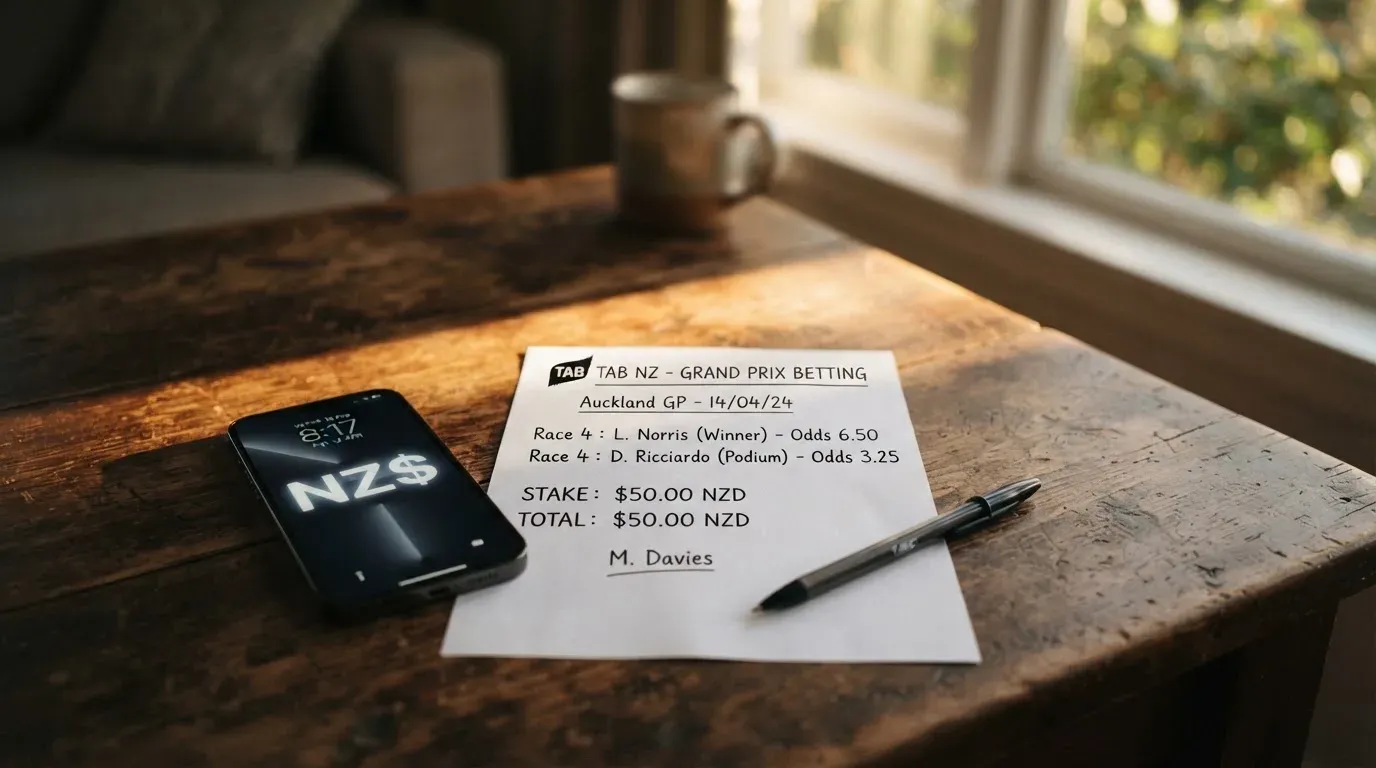
TAB NZ is the monopoly operator, made up of two brands you can use today. TAB itself is the flagship product with the betting app on the New Zealand App Store. Betcha is the newer sibling published by Entain NZ, the long-term operating partner that took over the TAB platform under a 25-year agreement signed in 2023. From the punter’s point of view they look different — Betcha’s interface is more modern and it focuses on sports, racing and esports — but behind the scenes they share the same betting engine, the same wallet, and the same self-exclusion list. They are not rivals and it is not possible to arbitrage between them.
After TAB and Betcha, the rest of the market is offshore. Roobet, Spinbara, Sportaza, Thunderpick, RoosterBet, Glorion, RoyalistPlay, and BetAlright all accept New Zealand customers in the technical sense: their sites load, they take deposits in crypto or card, and they pay out winners. What they do not have is a New Zealand licence, a New Zealand complaints route, or any access to the harm-minimisation tools TAB NZ is required to build. They are not lawful under section 74AAA of the Racing Industry Act 2020, and that section was inserted in 2025 by the Racing Industry Amendment Act and came into force on 28 June 2025. The Department of Internal Affairs told overseas providers serving New Zealand customers to withdraw with immediate effect that day.
Every comparison in the table below has to be read with that line in mind. Within the lawful group there is one choice: TAB or Betcha. Beyond that, every brand you see has a Curaçao, Anjouan or Tobique licence, none of which gives the right to take bets from people in New Zealand, and the page describes rather than recommends.
The Legal Frame Around Betting on F1
Legality in New Zealand is set by the Racing Industry Act 2020 and its 2025 amendment, with the Department of Internal Affairs as the gambling regulator. The Gambling Act 2003 covers casino gambling and is not where the betting monopoly lives. Knowing which Act you are under matters because the rules, the levies, and the harm-minimisation framework are different.
Section 74AAA is the line to remember. It says no person other than TAB NZ may offer racing betting, sports betting or other racing or sports betting to a person in New Zealand, regardless of where that person is resident or incorporated. Penalties for breach are not stated in the section and no prosecution of an offshore bookmaker was found at the time of writing. New Zealand does not block bookmaker sites, so the prohibition is enforced against the offshore operator, not against you. Section 19(4) of the Gambling Act 2003, inserted in 2025, says an individual may not be convicted for placing a bet with an offshore operator in breach of section 74AAA. None of that makes offshore betting safe. It just shifts liability to the operator, with the regulator’s warning that overseas operators may be in jurisdictions with minimal consumer safeguards, may not return unspent credits, and may not pay out large wins.
The Online Casino Gambling Act 2026 licenses online casino gambling only. TAB New Zealand was among those who had the right to apply for a casino licence, but the right to take sports and racing bets is not extended by that licence — it is held separately by section 74AAA. The point-of-consumption charge on offshore racing and sports betting ceased on 30 June 2026, and TAB NZ pays a Problem Gambling Levy of 0.74% on its gross proceeds from 1 July 2025 to 30 June 2028. None of these payments is a substitute for a licence. Paying tax does not make an offer lawful.
Where Help Is If a Bet Goes Wrong
Responsible gambling in New Zealand runs through TAB NZ’s own tools and a national helpline, not through a multi-register the way some countries run it. If you can bank to TAB NZ you can bet there, and the protection package comes with the operator. If you are using an offshore bookmaker, the protection package is whatever the operator decides to give you, in a licence regime that does not owe anything to New Zealand.
TAB NZ’s app carries deposit limits, time-outs and self-exclusion. The exclusion applies across TAB and Betcha, so closing one closes both. The free Gambling Helpline is 0800 654 655, with a text line at 8006, run by the Safer Gambling Aotearoa service. None of this is a substitute for a self-imposed break. The tools are there to be set, and the helpline exists for the day they are not enough. Self-exclusion on an offshore brand, where one is offered, sits in the same operator’s wallet only; closing one offshore account leaves every other one open.
The age rule is firm. You must be 18 to bet with TAB NZ, which is the legal age for racing and sports betting under section 89 of the Racing Industry Act 2020. Land-based casinos run to 20. Offshore brands publish their own minimums in their terms; many will not say who you are or where you live.
Predictions, Tips and What They Are Worth
Search interest in F1 betting lands a lot of weight on tips, predictions and analysis. Most of that traffic is for content that describes what other people think about a race and what they have backed, not for primary information you cannot get on your own. Treat that content the way you treat a finance article: as one view among several, useful for spotting things you might have missed, not as a basis for a bet.
A sharp bettor does three things weekly in the F1 season. First, read the practice pace and long-run fuel loads from the Friday sessions. Second, watch how the market moves through qualifying — a driver whose odds shorten into qualifying is one the market has more information on than you do, and a price that drifts has a reason. Third, read the steward’s notes on grid penalties and parc fermé changes; anything mechanical on a car before the race is not in the betting market until someone flags it. None of that is a prediction. It is the work that makes the prediction legible.
What tips sites cannot do is tell you who will win a race. F1 is a sport of 23 variables, a tyre cycle and a safety car window that opens once or twice. Past performance is a guide, not a guarantee, and any tip that promises a winner is selling you certainty that does not exist. The page makes no predictions and offers none, and the same caution extends to “systems” that turn an analysis into a way to win every week. There is no such system. Anybody selling one is selling something else.
Markets, Odds and What Prices Mean
F1 betting offers more markets than most motorsports bookmakers run. The list below covers what TAB NZ and similar books carry, with a note on how each market settles. The market list matches what a buyer of an F1 race sees: race winner, podium, fastest lap, head-to-head, qualifying positions, the Drivers’ Championship, and the Constructors’ Championship.
Race winner is the simplest. You back a driver to win the race. Returns are paid out at the price you took, settled on the official FIA classification. Podium is the same, settled on a top-three finish. Fastest lap is settled on the official FIA timing, and some books void it if the driver who set it retired from the race. Head-to-head is the binary match: which of two drivers finishes ahead. Useful in qualifying too.
Outrights are different. Drivers’ Championship is a season-long market at most books, settled on the final championship standings at the final round in Abu Dhabi. Same idea for Constructors’. Outrights offer bigger numbers because the field is deeper. That depth is also where the bookmaker’s margin sits: the more outcomes, the harder it is to be right, and the margin compounds.
The other piece to know about odds is decimal vs fractional. New Zealand bookmakers publish in decimal form — a $2.10 price returns $2.10 per dollar staked, including the stake. Fractional odds are not the local standard; convert mentally by adding 1, so 6/4 becomes 2.50. The price you read is the price you take; it does not move after you have placed the bet except in the running market.
| Provider | New Zealand status | What their own terms say about F1 betting |
|---|---|---|
| TAB | TAB NZ brand — sole lawful operator | Markets on every Grand Prix of the calendar, race winner and podium, fastest lap, head-to-head, qualifying, Drivers’ and Constructors’ Championship outrights. |
| Betcha | TAB NZ brand — sole lawful operator | Same F1 markets as TAB in the same betting engine; modern interface and quick-pick coupons that centre on race day. |
| Roobet | Not licensed in New Zealand | Sportsbook covers soccer, basketball, tennis, esports and similar; no specific F1 race winner market visible from the home page; terms require 18+. |
| Spinbara | Not licensed in New Zealand | Sportsbook with cash out, Bet Builder and live markets; F1 outrights and race markets exposed through the sportsbook tab. |
| Sportaza | Not licensed in New Zealand | Cash out, Bet Builder, multiples, Asian lines, and interval markets in 1, 5, 10 or 15-minute slices; F1 listed in major sports. |
| Thunderpick | Not licensed in New Zealand | Cash out, Champions League to NFL markets; F1 listed as a motorsport in the schedule. |
| RoosterBet | Not licensed in New Zealand | Six odds formats; live and pre-match views, schedule and results; F1 offered through the motorsport section. |
| Glorion | Not licensed in New Zealand | Pre-match and live betting, virtual sports and esports; motorsport section carries F1 race winner and podium. |
| RoyalistPlay | Not licensed in New Zealand | Live betting, schedule and predictions; F1 race markets exposed in the motorsport menu. |
| BetAlright | Not licensed in New Zealand | Football, tennis, basketball and motorsport; live betting and virtual sports; F1 race markets exposed in the sportsbook. |
TAB NZ’s two brands carry the same F1 markets under the same betting engine. The offshore bookmakers vary in how F1 sits in their menus: some carry full race day cards with qualifying and fastest lap, others list motorsport as a side section. None of the offshore books has a New Zealand licence, and the same caveat applies to every one of them.
The Formula 1 Calendar and What to Read Into It
The 2026 FIA Formula One World Championship is the 77th running of the World Championship and the schedule shapes what the betting market looks like for the rest of the season. Twenty-three Grands Prix are scheduled, with eleven teams on the grid. Saudi Arabia was originally on the calendar and was later cancelled, which is why 24 became 23.
The season opened at the Australian Grand Prix at Albert Park, Melbourne, on 8 March 2026, and is scheduled to close at the Abu Dhabi Grand Prix at Yas Marina on 6 December 2026. Six sprint weekends sit on the calendar, which is what the betting market calls “sprint” markets on top of the main race. The sprint rounds for 2026 are China, Miami, Canada, Britain, Netherlands and Singapore. Six sprints is six additional race card days in the year.
The reigning champion coming in is Lando Norris, after he won the Drivers’ Championship at the back end of the 2025 season. McLaren are not the only story; the field changes a lot from 2024 forwards, and the betting market reflects that. The other big change is on the technical side. The 2026 rules removed the MGU-H, lifted MGU-K from 160 bhp to 470 bhp (350 kW), and replaced DRS with active aerodynamics, which changes overtaking on track and on screen. The driver cost cap is up: each team now spends up to $215M, from $135M the year before.
For a bettor, the calendar tells you two things. First, sprint weekends double up the race card, and the books add a same-race-day market for the sprint. Second, a calendar shaped around an Australian opener and an Abu Dhabi close gives you a five-month run of three-race weekends in the middle of the year and a long back end. The market warms up at the same pace the calendar does.
What a Betting Site Actually Promises to Do
The mechanics of how a betting site presents itself to you are worth knowing in the abstract, because every review you read will pivot on them. These are the moving parts a tab account, a Betcha account and an offshore bookmaker all share in their own way.
- The market screen is the page that lists the day’s events and the selections inside each. Each event is its own card with runner names and odds next to them. In F1, the race card is split into one card for race winner, one for podium, one for head-to-head, one for fastest lap, and so on.
- The bet slip is the on-screen box where your selections accumulate. A stake box appears next to each leg, with a return calculated in real time as the odds move. Same-game multis and outrights are the two bet-slip formats that fold multiple legs together.
- The wallet holds the money you have deposited and the bonus balance the book has given you. Withdrawals go through the same wallet, with a settlement window that varies. The deposit methods an offshore book accepts may not be the same set TAB NZ accepts, and the limits often differ.
- The account is the surface where limits, time-out periods and self-exclusion are set. TAB NZ makes these tools available across both its brands. Offshore books vary; some don’t offer a self-exclusion at all.
- Cash-out is the feature that lets you close a bet before the race finishes, at a price the book quotes. Sportaza, Thunderpick and Spinbara carry it. TAB NZ doesn’t carry it the same way. Cash-out is useful to know about; it costs a margin, and the price is set by the book.
The Bookmaker’s Margin and How to Spot It
The bookmaker’s margin is the piece of every price that is not return-to-punter. It is the cut the book takes before a cent reaches a winner. Markets with two runners and prices close to 2.00 / 2.00 are the cleanest illustration of where it lives: every $1 of stake across both sides returns a fraction less than $1 to the punters. The slice the book keeps is the margin.
A worked example on a two-way market priced 1.90 / 1.90 (these are example prices, not a quoted market): the payout share, before the book takes anything, is 1 divided by the sum of 1/1.90 plus 1/1.90, which works out to about 0.526 of the stake pool — meaning the book keeps a margin of about 47 cents on the dollar. In an F1 context that is much wider than the actual line for a head-to-head on race winner; the same market on a balanced pair of drivers, priced closer to 1.95 / 1.95, gives the book closer to 5 cents on the dollar. The margin varies not only by market but by how the book has set its prices on that day.
The figure worth remembering is that the bookmaker’s margin is everything that is not your payout, and on most major F1 books it sits somewhere between 5% and 10% for the popular race-winner markets. Wider-than-usual margin shows up where the field is large — long-shot outrights — and at the edge of the betting card. The margin is small enough to ignore on the cards you back most often and is wide enough to notice in live betting, where the book updates prices the same minute and the margin per quote can be larger.
A clean price on a book is one where the implied payout across all outcomes is below 100%. Adding up every price’s reciprocal and dividing one by the sum gives the payout share. Subtracting from 1 gives the margin. That exercise is the fastest way to spot a book that has unusually wide margins, and the one to do before you place the bet.
Reviewed Operators
The two TAB NZ brands first, then the offshore books that an NZ punter may already be using. Each is described as their own terms state them; rated rather than advertised.
TAB
TAB is the long-standing New Zealand bookmaker. The brand published its app on the New Zealand App Store on 8 September 2014 under the seller name New Zealand Racing Board. TAB NZ took a long-term operating partnership with Entain that runs for 25 years from 2023, splits gross profit 50/50 with Entain after at least $150m a year to TAB NZ for the first five years, and brought a $100m one-off payment to the racing sector. The brand covers horse racing, harness racing, greyhound racing, rugby union and rugby league, all the major local sports, and the international calendar including Formula 1.
Worth it if you are an NZ punter who wants the only safe path through the market. TAB gives you access to race-winner, podium, fastest-lap, head-to-head, qualifying, and Drivers’ and Constructors’ Championship outrights for every Grand Prix and sprint weekend, settled in New Zealand under the Racing Industry Act, with the regulator on the side of the punter. The downsides are familiar: a dated interface, racing-first menus, and no welcome bonus worth chasing.
Betcha
Betcha is the second online brand of TAB NZ, published by Entain NZ on the New Zealand App Store on 6 August 2024. The product is targeted at a sports-first audience and serves F1 markets through the same betting engine TAB runs on. Coverage includes horse, greyhound and harness racing plus rugby, NRL, MMA/UFC, NBA, NFL, tennis, cricket, football, motorsports and esports.
Worth it if you want the F1 markets in a modern interface and a sports-first product, and you accept the same TAB NZ cover for safety. The user experience is the differentiator. A bettor willing to back Saturday’s Grand Prix and Sunday’s sprint in the same wallet can do both through Betcha without switching products; the F1 market is deeper on the live side and there is faster odds movement.
Roobet
Roobet is a Curaçao-licensed sportsbook and casino. The licence is held by Raw Entertainment B.V. under OGL/2024/687/0427. The product covers soccer, basketball, tennis, esports (Counter-Strike, FIFA), baseball, ice hockey, MMA and table tennis, and the terms require customers to be 18 or older. F1 is not on the headline list on its home page and may sit under a motorsport or “others” section if at all.
Worth ignoring if you are betting on F1 from New Zealand. Roobet has no F1 race-card market of substance from what its home page shows, is not licensed in New Zealand, and the Curaçao licence gives no recourse through the Department of Internal Affairs. The decision isn’t which licence looks better; it’s that you don’t have a New Zealand licence for this product. Move on.
Spinbara
Spinbara is a sportsbook and casino with a Curaçao licence. The product advertises a 100% first deposit bonus up to EUR 100, a sports crypto welcome bonus of 100% up to 200 USDT, plus a casino welcome bonus of 100% up to EUR 500 and 200 free spins. The sportsbook offers Bet Builder, cash out and live markets.
Worth ignoring for a regular F1 bettor. The brand offers cash out and a full sportsbook including motorsport, but the Curaçao licence has no reach into New Zealand. If you are evaluating Spinbara as a sportsbook, the relevant fact is what you can do with F1 from the Bet Builder menu and how the bonus terms land — not whether the brand is suitable as a TAB replacement.
Sportaza
Sportaza runs an Anjouan licence under ALSI-202606064-FI2 and offers a comprehensive sports product. Cash out before an event or market is finalised is the headline feature, alongside Bet Builder (if one leg is void the whole slip is void), multiples, Asian lines, and interval markets split into 1, 5, 10 or 15-minute slices.
Worth noting if you are shopping for an offshore book with a full cash out and Bet Builder setup. Motorsport sits under “others” or as a side sport on most lists, and F1 is treated as part of the calendar. The relevant caution is the same for every offshore brand: no New Zealand licence, no New Zealand complaints route, and any liability you have against the operator is through a regulator in a jurisdiction outside the country.
Thunderpick
Thunderpick is an esports-first sportsbook and casino with a Curaçao licence held by Paloma Media B.V. under OGL/2024/677/0722. The sports side covers cash-out betting from the Champions League to the NFL and adds esports categories such as CS2, League of Legends, Dota 2 and Valorant. F1 sits in the schedule under motorsports.
Worth trying if your F1 interest is intermittent and you are an esports-first punter who wants the same wallet for both. The product is competitive on cash out and odds movement. The relevant caution is unchanged: no New Zealand licence, and the Curaçao licence does not bind the operator to the harm-minimisation framework TAB NZ builds.
RoosterBet
RoosterBet is a Tobique-licensed sportsbook under Tobique Gaming Commission e-gaming licence number 0000002, holder Novatrix SRL. The product carries six odds formats, with Live, Sports Promotions, Results, Schedule, E-sports and Predictions sections. The prediction feature is the differentiator: it lists short-form views from other users inside the product.
Worth ignoring for an F1 bettor who already has a TAB or Betcha account. The product is broad enough that F1 is in there somewhere. The Tobique licence is offshore, not New Zealand, and the Diaz warnings about consumer safeguards, unspent credits and big-win payouts are the same as for every other brand on this page.
Glorion
Glorion runs an offshore sportsbook and casino covering pre-match and live betting, virtual sports, horse racing and esports, with markets grouped into popular, niche, indoor and outdoor sports plus entertainment events such as award shows and elections. The brand names no licence that applies in New Zealand.
Worth noting only as a backstop if you are using the brand for reasons unrelated to F1. The relevant caution is that the market list is broad enough that a market exists but not deep enough to be a primary F1 book. Stick with TAB or Betcha for race-card betting; treat this as a side option.
RoyalistPlay
RoyalistPlay is a Tobique-licensed sportsbook under e-gaming licence number 0000002, holder Novatrix SRL. Live betting, sports promotions, results and schedule sections carry football, basketball, tennis, handball, ice hockey, volleyball and table tennis, with separate e-sports and Predictions sections.
Worth trying as a sportsbook for sports other than F1. The product may suit a multi-sport punter who wants a single wallet across football, basketball and tennis, but F1 sits in the motorsport menu and isn’t a deep market on this product. The Tobique licence has no reach into New Zealand, and the same Diaz warnings apply as for any offshore brand.
BetAlright
BetAlright runs an offshore sportsbook and casino with no licence applicable in New Zealand. The product covers football, tennis, table tennis, basketball, ice hockey, American football and baseball, with Live Betting and Virtual Sports sections.
Worth noting only as a reference. F1 is not on the headline list, motorsport may sit under “others” or as a side sport, and the product is more football-heavy than TAB or Betcha. The lack of an applicable New Zealand licence puts it in the same offshore category as the brands above.
What to Pick and Why
The decision is sharp. There are two lawful options and a longer list of offshore books. The right choice depends on whether you care about the harm-minimisation framework and the regulator on your side, or whether you care about the depth of the live market.
If you want a betting operator that sits inside the New Zealand consumer protection system with verified ID, deposit limits, time-outs, a self-exclusion that covers both brands, and a regulator (the Department of Internal Affairs) you can write to if anything goes wrong, choose TAB or Betcha. The choice between them is mostly about the interface. TAB is racing-first with a familiar multi-bet workflow. Betcha is sports-first with a more modern product. Both settle under the same rules and both settle on the official FIA classification.
If the only thing that matters to you is depth on the live market and exotic markets like Asian lines or 5-minute intervals, you will not find that here in the lawful group. The offshore books offer it, with a different cost in protection: no New Zealand complaints route, no harm-minimisation framework that reaches your account, and a regulator (Curaçao, Anjouan or Tobique) that does not owe New Zealand anything. The right framing is not “TAB is the only safe choice and offshore is dangerous”, and the right framing is not “offshore is fine because the law targets the operator”. The right framing is that you choose the protection package you want and you pay for it in the product you use.
The other choice you have is whether to bet at all. F1 is a sport with 23 races on the calendar and a sprint on six weekends. That gives you plenty of opportunity, and plenty of opportunity to overplay. Pick a stake you can lose and a market you understand, and stop when the form says stop.
FAQ
Where can I bet on Formula 1 in New Zealand?
TAB and Betcha are the only lawful operators for racing and sports betting in New Zealand since 28 June 2025. Both are run by TAB NZ (TAB New Zealand) under section 74AAA of the Racing Industry Act 2020. Other bookmakers do not have a New Zealand licence, and the Department of Internal Affairs has told overseas providers to withdraw with immediate effect. So far as race-day markets go, the safe route is TAB NZ’s two brands only.
How do decimal odds work in New Zealand?
Decimal odds are the price per dollar staked, including the return of the stake. A $10 bet at $2.60 returns $26 — your $10 stake plus $16 in profit. Decimal is the standard format on TAB NZ and is the only published format on the New Zealand platform. Fractional odds that you may meet on offshore books read 6/4 = 2.50, 5/1 = 6.00 and so on.
What is the bookmaker’s margin?
The margin is the slice of every stake pool the book keeps before paying out winners. Add up every outcome’s 1 / price across the market; that gives the payout share. The remainder is the margin. A market where the implied payout is below 100% has a margin; the closer to 100%, the thinner the margin. On a typical F1 race-winner market the book keeps between 5% and 10%.
What is a same-game multi in F1?
A same-game multi stacks several F1 selections from the same event into one bet. TAB NZ offers these as Same Game Multis. The odds multiply together for a single composite price, and any single losing leg voids the whole slip at most books. Sportaza spells this rule out in its terms: if one leg is void the whole slip is void on Bet Builder.
Is offshore F1 betting legal in New Zealand?
Section 74AAA of the Racing Industry Act 2020, in force since 28 June 2025, makes it unlawful for an offshore operator to take racing or sports bets from a person in New Zealand. The Department of Internal Affairs targets the operator, not the player. Section 19(4) of the Gambling Act 2003, inserted in 2025, says a person may not be convicted for placing a bet with an offshore operator in breach of section 74AAA. None of that gives an offshore bettor a New Zealand complaints route if something goes wrong.
What happens to F1 bets if a driver changes teams mid-season?
Outright bets on a Driver’s Championship or a Constructors’ Championship are settled on the final standings, so a mid-season team change does not void them. Race winner and podium markets are settled on the official FIA classification in that race, so a driver changing teams in a race settles in their final classification. Read the betting rules before any specific market for the detail; the house rules cover each case.
What is a sprint weekend?
Sprint weekends are six Grand Prix events on the 2026 F1 calendar that add a sprint race on Saturday in addition to the Sunday Grand Prix. The sprint rounds are China, Miami, Canada, Britain, Netherlands and Singapore. TAB NZ runs sprint markets as a separate race card with its own race-winner and head-to-head markets.
Tennis, golf & more – kiwiracingbets
Content created by the «kiwiracingbets» team
