Multi Bets in New Zealand: What a Multi Really Pays When TAB NZ Is the Only Legal Bookmaker
 Available in US
Currency stamp: figures verified as of October 30, 2026 against TAB NZ’s published betting rules and the Racing Industry Act 2020.
A multi bet is the single wager a New Zealand punter is most likely to lose without understanding why. The legs all look reasonable on the slip, the combined price looks generous on the screen, and the bet gets placed. The mechanics are not intuitive: every leg multiplies into the final price, a single losing selection voids the whole ticket, and the bookmaker’s margin runs through each leg separately before the product is taken. Knowing that much is necessary. Knowing what TAB NZ’s monopoly under section 74AAA of the Racing Industry Act 2020 does to the choice of bookmaker, and what same-game multis change about that arithmetic, is what turns the wager into one a punter has actually chosen.
This page works through the mechanics first, then through what the consequences of the monopoly are for who is taking the bet, what they pay for it, what the responsible-gambling framework covers, and what an offshore brand cannot lawfully offer. It then goes through the bookmakers a New Zealand punter actually meets, the bets themselves from doubles up to Heinz and Super Heinz, and the worked examples that show what a multi returns across a band of decimal odds.
How a Multi Bet Is Built, Priced and Settled
What a multi is, in the language TAB NZ uses
A multi bet, also called an accumulator, a parlay or an acca, is a single bet that links two or more individual wagers. The selections have to all win for the ticket to pay, and the payout odds are the product of the odds of each selection, which is why decimal odds — the form TAB NZ writes on its slip, like 2.10 — suit them. New Zealand racing culture uses the older word “bet” and the modern “multi” interchangeably; the betting rules call it a “Multi” or a “Same Game Multi” when the legs come from one event rather than several.

A leg that ties — a push — is removed, and the payout odds are reduced to the product of the remaining selections. A losing leg loses the whole bet, regardless of how strongly the others are paying. There is no partial payout on a multi.
What a multi pays, in the worked arithmetic
The arithmetic for a multi is the multiplication of decimal odds across the legs, then the stake times that product for the return, and the stake times the product minus the stake for net profit.

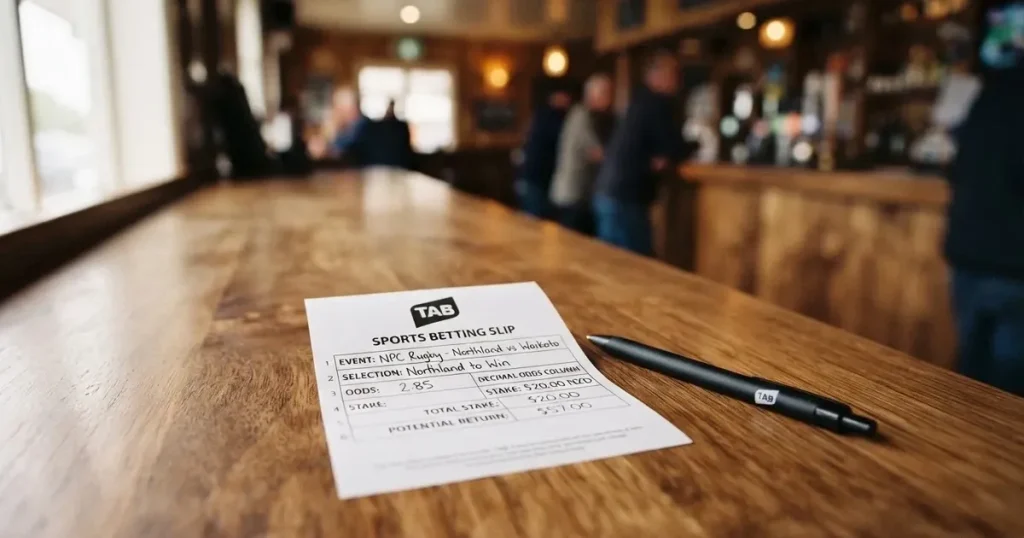
Take three illustrative selections at decimal odds of 1.50, 2.00 and 2.50 with a $10 stake. The product is 1.50 × 2.00 × 2.50 = 7.50. A winning ticket returns $10 × 7.50 = $75 including the stake, which is $65 of net profit on the $10 risked. If one leg loses, the return is zero and the $10 stake is gone. The same arithmetic holds for a same-game multi: the legs still come from one event, but they still multiply, and one losing leg still costs the whole bet. A push on one leg reduces the product to the remaining selections; it does not save the bet if a third leg loses.
The product grows fast and so does the variance. Two legs at 1.50 each already give a product of 2.25; four legs at 2.00 each give 16.00, which is a $160 return on a $10 stake — and a four-leg multi needs every one of those four prices to land. The marketing on a betting app tends to lead with the headline return on a winning ticket. The honest framing leads with the probability of needing all legs to win at the same time, with the bookmaker’s margin already inside each price.
Same-game multi, and how it differs
A same-game multi (SGM) is a multi whose legs come from one event — for example, the All Blacks to win, the total points scored to be over a line, and a player to score a try, all from the same match. The arithmetic is identical to a multi with legs from different events: legs multiply, one loss voids the ticket, a push removes the leg. What is different is correlation. The legs of a multi are usually treated as independent, so the offered price is roughly the product of the single prices. The legs of a same-game multi are not independent: an All Blacks win and an All Blacks-over-the-total-points line both become more likely when the All Blacks are winning comfortably, so the offered price is usually shorter than the product of the singles suggests. TAB NZ publishes same-game multis on racing and major sports fixtures; the price shown is the price taken, and the punter cannot re-derive it from singles.
Fixed cover bets: from a Trixie to a Super Heinz
The full-cover bets are what TAB NZ and most sportsbooks list as named combinations rather than as bespoke multis. The naming is fixed across the industry, and the number of bets grows quickly with the number of selections.
A Trixie is a full cover bet on 3 selections made up of 4 bets: three doubles and one treble. A Yankee covers 4 selections in 11 bets: six doubles, four trebles and one four-fold. A Heinz covers 6 selections in 57 bets — fifteen doubles, twenty trebles, fifteen four-folds, six five-folds and one six-fold. A Super Heinz covers 7 selections in 120 bets, and a Goliath covers 8 selections in 247 bets. The stake is multiplied by the number of bets in the cover: a $1 stake on a Trixie costs $4; a $1 stake on a Heinz costs $57; a $1 stake on a Super Heinz costs $120. The cover pays whenever enough legs win to fill one of the included multiples — a Trixie still pays a double if the treble loses; a Yankee still pays a double if the treble and four-fold lose.
A cover bet is not the same thing as a multi. A multi is one bet whose price is the product of every leg; a cover is a package of multiples that pays on smaller combinations when the full combination loses. A punter choosing between a 4-leg multi and a Yankee on the same four selections is choosing between one bet that needs all four to win and a package of eleven bets that still pays on combinations of two or three.
Push, void and the rules TAB NZ applies
A push in a multi is treated as a non-runner for that leg: the leg is removed and the price of the multi is reduced to the product of the remaining legs. A void leg in a TAB NZ multi follows the same rule, because the betting rules define a void selection as one that has not taken a price. A leg ruled non-runner after the bet is placed — a scratch runner, a player withdrawn before the event — is refunded on that leg and the multi is recalculated. A leg that loses at any point in the event voids the whole multi; there is no second chance.
Where the bookmaker’s margin sits
Every price TAB NZ posts already contains its margin. The margin is what the bookmaker keeps of every unit bet on a market, and on a multi it sits inside each leg before the product is taken. A multi with three legs each at a 5% margin is not at a 5% margin overall; it is at a margin that is close to 1 − (1 − 0.05)³ and operates at roughly 14% on a true-price basis, before any same-game correlation adjustment on an SGM. The marketing-led framing of “boosted odds” on a multi adds a fraction to the headline product without removing it. The punter pays the margin on every leg they bet on, and on a multi they pay it several times over.
The Statutory Frame Around Every Bet Placed in New Zealand
Section 74AAA and what it does
The Racing Industry Act 2020 establishes TAB NZ as the sole betting provider for racing and sports in New Zealand. The Racing Industry Amendment Act 2025 inserted section 74AAA, which took effect on 28 June 2025: no person other than TAB NZ may offer racing betting, sports betting or other racing or sports betting to a person in New Zealand, regardless of where that person is resident or incorporated. The Department of Internal Affairs told providers serving New Zealand to withdraw with immediate effect. There is no licence to apply for and no licence register for bookmakers, because there is only one lawful provider.
TAB and Betcha are the two lawful online brands of TAB NZ, run by Entain under a 25-year agreement signed in 2023 that gives Entain a 50/50 share of gross profits, with at least $150m a year going to TAB NZ for the first five years, and Entain pledged a one-off $100m payment to the racing sector. They are not rivals. They are two front doors of the same operator.
What the law does not do
New Zealand law does not geo-block offshore websites. It puts liability on the offshore operator that serves a person in New Zealand; the penalty for breaching section 74AAA is not stated in the section and no prosecution of an offshore bookmaker was found. Section 19(4) of the Gambling Act 2003 (inserted in 2025) says an individual may not be convicted for placing a bet with an offshore betting operator in breach of section 74AAA — so no published penalty for a player was found. The honest framing is: the operator is the target; the player carries the regulator’s stated warnings and the limits set by the offshore brand itself.
What may be bet on, and by whom
The ban covers events held inside and outside New Zealand. The age for TAB NZ betting is 18 (betting under 18 is an offence under section 89 of the Racing Industry Act 2020); land-based casinos are 20, which is a separate regime and is never merged with the betting age. TAB NZ takes fixed-odds and tote bets; its published betting rules define standard racing and sports bets. Live betting is listed in the TAB NZ apps; any statutory restriction on in-play markets is not established. No lawful New Zealand betting exchange exists and spread betting is outside TAB NZ’s sports-betting definition. Bets on politics and novelty markets: not established. There is no statutory per-bet cap; limits are TAB NZ’s own terms.
Greyhound racing is closing in stages from 1 August 2026, and from that date offshore operators may not take bets on greyhound races either. Esports betting’s status under the Racing Industry Act is not established; virtual sports are treated by the 2026 online casino law as casino gambling. The Online Casino Gambling Act 2026 licenses online casino gambling only; TAB New Zealand winning the right to apply for a casino licence does not extend the betting monopoly.
Advertising, affiliates and the gambling advertising code
Because only TAB NZ may offer betting here, the Department of Internal Affairs reads the prohibition as covering promoting or taking such bets for another operator. How DIA treats betting affiliates is not established, so a comparison of brands stays descriptive and does not invite readers to sign up with one outside the monopoly.
The Advertising Standards Authority’s Gambling Advertising Code applies to betting advertisements: ads must not target children (under 14) or young people (14 to under 18), judged by context, appeal and expected audience (25% or more of the audience counts as significant where accurate data exists), must not encourage harm, and must be truthful with terms available. There is no New Zealand equivalent of a “whistle-to-whistle” ban for betting. TAB NZ runs “bonus bets” promotions; no New Zealand rule on bet-bonus size or wagering terms was found, so what is on offer is described only as TAB NZ’s own terms state it.
Tax
For the player, Inland Revenue guidance says recreational gambling winnings are generally not taxable and prize money from TAB horse, dog and trotting races is not taxable. A person who bets as a business is a different case — general information, not tax advice.
On the operator side, TAB NZ pays the Problem Gambling Levy of 0.74% (in force from 1 July 2025 to 30 June 2028). Overseas operators supplying New Zealand residents pay online gambling duty (12% of profits since 1 July 2024, 16% from 1 January 2027). A duty being payable does not make an offer lawful — never write that tax payment shows a bookmaker is legal. The point-of-consumption charge on offshore racing and sports bets ceased on 30 June 2026.
What Responsible Gambling Looks Like at TAB NZ
The tools the app lists
TAB NZ lists deposit limits, time-outs and self-exclusion in its app, and an exclusion applies across its brands (TAB and Betcha). Safer Gambling Aotearoa and the free Gambling Helpline (0800 654 655, text 8006) are the published help channels. There is no single national online-betting exclusion register: the register the 2026 online casino law will require is for online casinos only.
A self-exclusion at TAB NZ locks the account across both brands in the period of exclusion, and any deposit limit applies to every channel the punter can reach through the same account. Setting a deposit limit is the cheapest harm-minimisation step a punter can take, and it is the one that survives a losing streak better than willpower. The 0800 number is free from a New Zealand phone and the text line at 8006 is for people who do not want to speak on the phone.
What the framework covers and what it does not
The framework covers TAB NZ and Betcha only. It does not reach an offshore brand a punter is also using. The Department of Internal Affairs warns that overseas operators may be in jurisdictions with minimal consumer safeguards, may not return unspent credits and may not pay out large wins. The warning is general. A punter comparing a TAB NZ multi against an offshore same-game multi is also comparing a fully covered dispute route against no dispute route — and that difference is what the responsible-gambling framework rests on, not on the size of a welcome offer or the depth of a market.
Greyhound racing and harm minimisation
Greyhound racing closes in stages from 1 August 2026. After that date, no New Zealand-licensed operator may take bets on greyhound races and no offshore operator may lawfully do so either. The closure is part of the racing industry’s response to welfare findings and is not driven by betting-revenue concerns. A punter whose multi included a greyhound leg will see that leg voided on the slip once the closure date takes effect, and the multi will recalculate accordingly — which is the same rule that applies to any non-runner.
Bonuses and Free Bets: What a TAB NZ Promotion Actually Adds
What TAB NZ calls a bonus bet
TAB NZ runs “bonus bets” promotions. A bonus bet is a credit the punter wagers rather than cash, and the stake is usually not paid back with a win — so a winning $5 bonus bet at $3.00 returns $10, not $15. The headline is “free”; the arithmetic is that the stake does not return. Reading the bonus-bet terms tells the punter which markets the bonus bet applies to, the minimum odds a leg has to be at, and the expiry.
What the wagering terms are
No New Zealand rule on bet-bonus size or wagering terms was found, so what is on offer is described only as TAB NZ’s own terms state it. A typical TAB NZ bonus-bet promotion credits the account after a qualifying wager at a settled market, with a minimum odds requirement on the qualifying bet and an expiry on the bonus bet itself. A punter who places the qualifying bet at the minimum odds and lets the bonus bet expire unused has paid the qualifying stake for nothing. A punter who uses the bonus bet on a multi at the minimum odds is paying the bookmaker’s margin on every leg, on a stake that does not return with a win — which is the trade-off every bonus bet makes.
Same-game multis and bonus bets
Same-game multis on TAB NZ are usually eligible for bonus-bet promotions on the same terms as singles and traditional multis. The minimum odds requirement applies to the combined price, not to each leg — so a same-game multi at a combined price of $3.00 meets a $1.50 minimum where three singles at $1.10 each might not. The trade-off is the same: the bonus bet does not return the stake, and the legs multiply.
Multi Bet Tips and Strategy: What the Page Will and Will Not Do
What a tip is, in plain terms
A multi bet tip is a set of selections a tipster publishes with a recommended stake. The tipster may be a professional or a community tipster on Betcha’s Bet Social section; the price is whatever the bookmaker is offering at the time the punter places the bet, not at the time the tip was published. A tip is a forecast. The market is still seeing the tip and pricing the tipster’s selections, and the bookmaker’s margin is still sitting inside every leg.
What a tip cannot do
A tip cannot turn a multi into a “sure” bet, a “10-fold cert” or a banker. A multi with N legs needs every one of those legs to win at the same time, and the probability of that happening is the product of the probabilities of each leg — which is the same arithmetic that gives the product of the odds. A punter following ten “best multi bets this weekend” tips from a tipster with a 55% strike rate on singles is following a tipster whose multi strike rate is below 55% on a two-leg multi and below 18% on a four-leg multi. The headline ROI on a winning multi is large; the strike rate is low; the variance is brutal.
What strategy can do
What strategy can do is manage the variance. A punter who backs singles at a positive expected value and uses multis as a smaller, separate bank is treating the multi as a higher-variance bet with a higher headline payout, not as a substitute for singles. A punter who backs only multis is concentrating variance on the worst market the bookmaker offers — a multi is the worst market the bookmaker offers because the margin compounds across legs. A punter who backs only one type of leg in a multi — favourites only, or overs only — is concentrating risk on the direction of one variable rather than diversifying across many, which is the opposite of what a multi is for.
The matched-betting framing
Matched betting is a staking strategy that uses a free bet or a price boost at a bookmaker, laid off at an exchange, to lock in a small profit regardless of the outcome. In New Zealand the lawful bookmaker is TAB NZ, and there is no lawful betting exchange; the matched-betting framing collapses for a New Zealand punter because the lay-off leg has nowhere lawful to go. An offshore exchange is itself a breach of section 74AAA by the exchange that serves a person in New Zealand, and the bettor has no New Zealand complaints route if the exchange fails to pay. “How to multi account matched betting” is a strategy that works in jurisdictions with multiple bookmakers and exchanges; in New Zealand, it does not have the legs to stand on.
Bet Types and Odds: From Doubles to Heinz in TAB NZ’s Programme
The bet types on the slip
TAB NZ’s published betting rules define standard racing and sports bets, including Win, Place, Each Way, Quinella, Exacta, Trifecta, First Four, Double, Treble, Daily Double, Running Double, Quaddie, Big6, and Multis and Same Game Multis. A Win bet backs the selection to finish first; a Place bet backs the selection to finish in the placed positions, which depend on the field size; an Each Way bet is a Win and a Place stake combined. Quinella, Exacta, Trifecta and First Four are finishing-order bets on racing. A Double is two selections on different events, both to win; a Treble is three selections on different events, all to win. A Daily Double is a Double on a nominated meeting; a Running Double is two selections at the same meeting, often on consecutive races. A Quaddie is a four-leg pool on nominated races, with the pool paid as a dividend; Big6 is a six-leg pool on a wider set of nominated races. A Multi is several selections in one bet, with a same-game multi taking its legs from one event.
Odds, dividend and the difference
Fixed-odds betting pays the price taken at the time of the bet, regardless of later market moves. Tote (pool) betting pays a dividend that depends on the pool size and the number of winning tickets. Quaddie and Big6 are pool bets — the dividend is declared after the last leg runs. Win, Place, Each Way, Quinella, Exacta, Trifecta, First Four, Double, Treble, Daily Double, Running Double, Multi and Same Game Multi are fixed-odds bets at TAB NZ. A punter who wants a known return at the time of placing the bet wants a fixed-odds bet; a punter who wants a share of a pool wants a tote bet.
Line betting and handicap
Line betting, also called handicap, sets a margin the favoured selection has to win by or the underdog has to lose by less than. A -1 line on a football team means the team has to win by two or more goals for the bet to win; a +1 line on the opposing team means that team has to win or lose by one goal or less. Line betting is a fixed-odds market and combines into multis the same way Win markets do. A same-game multi with a head-to-head line and a total-points line is two correlated legs from one event, and the SGM price is shorter than the product of the singles.
What the page will not do
The page will not name selections, will not call any multi a “sure” bet, will not print a working bonus code, will not invite the reader to sign up with an offshore brand, and will not call an offshore brand legal in New Zealand. The arithmetic is the arithmetic; the tipster’s picks are the tipster’s picks; the bookmaker’s margin is the bookmaker’s margin.
The Bookmakers a New Zealand Punter Actually Meets
The landscape, in one breath
The landscape has two lawful options and a long tail of offshore brands. TAB and Betcha are the two online brands of TAB NZ, the only provider lawfully offering racing and sports betting to people in New Zealand since 28 June 2025 (section 74AAA of the Racing Industry Act 2020); they are one operator group, never rivals. Other brands are listed because New Zealand players meet them — through advertising, through affiliate content, through offshore marketing — and each is marked “not licensed in New Zealand”. This is not a ranking and not a recommendation: never merge the two groups, never call a foreign brand legal, licensed, approved or safe in New Zealand.
| Brand | New Zealand status | What the operator’s own terms state on multi bets |
|---|---|---|
| TAB | TAB NZ brand (TAB NZ holds the monopoly under section 74AAA of the Racing Industry Act 2020, in force since 28 June 2025) | Published betting rules cover Multis and Same Game Multis; fixed-odds and pool bets; live betting in the app; same-game multis on racing and major sports |
| Betcha | TAB NZ brand (TAB NZ holds the monopoly under section 74AAA of the Racing Industry Act 2020, in force since 28 June 2025) | Daily Toolbox with odds boosts and insurance tools for non-winning bets; Bet Social section for punter chat, tipsters and shared bets; Playbook with tips and match analysis |
| Telbet | Not licensed in New Zealand — only TAB NZ may offer racing and sports betting to people in New Zealand (section 74AAA); brand names no licence that applies in New Zealand | No data on multi-bet rules under New Zealand law |
| BetAlright | Not licensed in New Zealand — only TAB NZ may offer racing and sports betting to people in New Zealand (section 74AAA); brand names no licence that applies in New Zealand | No data on multi-bet rules under New Zealand law |
| BigClash | Not licensed in New Zealand — only TAB NZ may offer racing and sports betting to people in New Zealand (section 74AAA); brand names a Curaçao licence (8048/JAZ), which gives no right to take bets from people in New Zealand | No data on multi-bet rules under New Zealand law |
| BillyBets | Not licensed in New Zealand — only TAB NZ may offer racing and sports betting to people in New Zealand (section 74AAA); brand names no licence that applies in New Zealand | No data on multi-bet rules under New Zealand law |
| Spinbara | Not licensed in New Zealand — only TAB NZ may offer racing and sports betting to people in New Zealand (section 74AAA); brand names no licence that applies in New Zealand | No data on multi-bet rules under New Zealand law |
| Rabona | Not licensed in New Zealand — only TAB NZ may offer racing and sports betting to people in New Zealand (section 74AAA); brand names a Curaçao licence, which gives no right to take bets from people in New Zealand | No data on multi-bet rules under New Zealand law |
| Roobet | Not licensed in New Zealand — only TAB NZ may offer racing and sports betting to people in New Zealand (section 74AAA); brand names a Curaçao licence (OGL/2024/687/0427), holder Raw Entertainment B.V., which gives no right to take bets from people in New Zealand | No data on multi-bet rules under New Zealand law |
| FunBet | Not licensed in New Zealand — only TAB NZ may offer racing and sports betting to people in New Zealand (section 74AAA); brand names no licence that applies in New Zealand | No data on multi-bet rules under New Zealand law |
TAB — the monopoly bookmaker and tote
TAB is the retail-and-online front door of TAB NZ. The published betting rules cover Win, Place, Each Way, Quinella, Exacta, Trifecta, First Four, Double, Treble, Daily Double, Running Double, Quaddie, Big6, and Multis and Same Game Multis. The TAB app — TAB – Racing & Sports Betting, first released on 8 September 2014 — lists live betting and the safer-gambling tools of deposit limits, time-outs and self-exclusion. The brand is the lawful bookmaker under section 74AAA, and the safer-gambling framework reaches it. A New Zealand punter who bets here is betting inside the regulator’s reach, with a complaints route, and with the responsible-gambling levy funding the Gambling Helpline.
The verdict on TAB is the same as the verdict on the monopoly: a punter who wants a New-Zealand-lawful bet with a published rules book, a regulator and a complaints framework gets it here, and nowhere else. A punter who wants a wider market menu, more payment methods or larger bonus bets goes to a brand that is not lawfully serving New Zealand and loses every protection the framework offers.
Betcha — the social front door of TAB NZ
Betcha is the second online brand of TAB NZ, run alongside TAB under the Entain partnership. The app lists a daily Toolbox with odds boosts and insurance tools for bets that do not land, a Bet Social section where punters chat, follow tipsters and share bets or pools, and a Playbook with tips and match analysis. The market menu is the same as TAB’s — the betting rules are TAB NZ’s rules — and the safer-gambling tools of deposit limits, time-outs and self-exclusion apply across both brands.
The verdict on Betcha is that it is the same bookmaker as TAB, dressed with social features and a daily promotional layer that TAB does not foreground. A punter who wants the social layer chooses Betcha; a punter who wants the longer-standing retail and racing heritage chooses TAB. A punter who reads them as rivals has read the marketing rather than the statute.
Telbet — crypto sportsbook, not licensed in New Zealand
Telbet describes itself as a crypto casino and sportsbook. It holds no New Zealand licence. Section 74AAA is clear: the brand cannot lawfully serve a person in New Zealand. A New Zealand punter who signs up here is outside the regulator’s reach, has no New Zealand complaints route, and is betting on the offshore brand’s own terms at its own limits. The Department of Internal Affairs warning about minimal consumer safeguards, unspent credits and large-win payouts applies.
The verdict on Telbet is that it is what it says it is, and it is not lawfully available to a person in New Zealand. A punter who wants crypto betting and accepts the loss of the New Zealand framework chooses it with eyes open. The page does not invite that choice.
BetAlright — operators over 18, not licensed in New Zealand
BetAlright accepts customers over 18 years of age only and has a separate partners site. It holds no New Zealand licence. The 18+ rule is the brand’s own; the lawful New Zealand betting age is also 18, but the rule that matters under section 74AAA is whether the operator may take the bet, not the age of the customer. BetAlright may not.
The verdict on BetAlright is that the 18+ rule is a customer-eligibility filter, not a New Zealand licence. A New Zealand punter who signs up here is outside the framework for the same reason as on any other offshore brand.
BigClash — pre-match, live, virtual and esports, not licensed in New Zealand
BigClash offers pre-match and live sports betting across international and local leagues, plus virtual sports and esports betting on FPS and MOBA titles. The brand names a Curaçao licence (8048/JAZ), which gives no right to take bets from people in New Zealand. The market depth is broader than TAB NZ’s on virtual and esports titles; the lawful availability to a New Zealand punter is none.
The verdict on BigClash is that a Curaçao licence is not a New Zealand licence. The wider menu is what the marketing sells; the loss of the New Zealand framework is what the marketing does not name.
BillyBets — three odds formats, not licensed in New Zealand
BillyBets offers bettors three odds formats: Decimal (2.00), American (+100) and Fractional (1/1). The format choice is a UI feature, not a licence. It holds no New Zealand licence. A New Zealand punter is used to decimal odds on the TAB NZ slip; the format choice does not change the legal status.
The verdict on BillyBets is that an odds-format toggle does not move the brand inside the New Zealand framework.
Spinbara — welcome offers in EUR and USDT, not licensed in New Zealand
Spinbara advertises a first deposit bonus of 100% up to EUR 100 and a sport crypto welcome bonus of 100% up to 200 USDT, alongside a casino welcome bonus of 100% up to EUR 500 plus 200 free spins. The page does not print a working code. The wagering terms behind the headline are the brand’s own and are not subject to a New Zealand rule.
The verdict on Spinbara is that the headline is the marketing and the framework is the statute. A New Zealand punter who wants the headline accepts that the framework does not apply.
Rabona — Soft2Bet sportsbook, not licensed in New Zealand
Rabona launched on 23 December 2019 as the sixth online sportsbook of the Soft2Bet group. The brand names a Curaçao licence, which gives no right to take bets from people in New Zealand. The market depth and the promotional layer are Soft2Bet’s; the lawful availability to a New Zealand punter is none.
The verdict on Rabona is that a Curaçao licence is not a New Zealand licence, and a brand group that has launched six sportsbooks has the marketing depth to reach a New Zealand punter without the licence to serve one.
Roobet — Curaçao licence 2024, not licensed in New Zealand
Roobet is a brand name of Raw Entertainment B.V., registration number 157205, Korporaalweg 10, Curacao, licensed under Curaçao licence OGL/2024/687/0427. The licence is Curaçaçao; it gives no right to take bets from people in New Zealand. The brand is widely advertised and widely used; the lawful availability to a New Zealand punter is none.
The verdict on Roobet is the same as on the other Curaçao brands: the licence is named, the framework is not reached.
FunBet — football, ice hockey, American football, basketball, volleyball, tennis, rugby, baseball, not licensed in New Zealand
FunBet’s sportsbook offers odds on football, ice hockey, American football, basketball, volleyball, tennis, rugby and baseball, with live betting and a bookmaker described as open 24/7. The market depth is broad and the live betting is round-the-clock. It holds no New Zealand licence; a New Zealand punter is outside the framework.
The verdict on FunBet is that a 24/7 live bookmaker with the major international sports covered is the marketing pitch. The pitch does not move the brand inside the New Zealand framework.
Worked Examples: What a Multi Returns Across a Band of Odds
A worked three-leg multi
The illustrative arithmetic in the mechanics section above is a 3-leg multi at decimal odds of 1.50, 2.00 and 2.50 with a $10 stake. The product is 1.50 × 2.00 × 2.50 = 7.50. A winning ticket returns $75 including the stake, which is $65 of net profit on the $10 risked. The same stake on a 2-leg multi at 1.50 and 2.00 — product 3.00 — returns $30, which is $20 of net profit. The same stake on a 4-leg multi at 1.50, 2.00, 2.00 and 2.00 — product 12.00 — returns $120, which is $110 of net profit.
The headline growth is the product, and it grows fast. The honest growth is the product minus the bookmaker’s margin compounded across every leg, which is why a same-game multi at the same combined product pays less than a multi of singles, and why a multi of short-priced legs pays less than its product suggests. The estimate is an average across many bets at the stated odds, not a guaranteed return on any one ticket.
A worked Trixie, Yankee and Heinz
A $1 stake on a Trixie (3 selections, 4 bets) costs $4. A $1 stake on a Yankee (4 selections, 11 bets) costs $11. A $1 stake on a Heinz (6 selections, 57 bets) costs $57. The stake is multiplied by the number of bets in the cover, and the cover pays on smaller combinations when the full combination loses. The cost is real money and is lost when every combination loses; the cover is a higher-stake bet on the same selections, not a cheaper one.
A punter choosing between a 4-leg multi and a Yankee on the same four selections is choosing between one $10 bet that needs all four to win and eleven $1 bets that still pay on doubles and trebles. The Yankee costs $11 instead of $10. The trade-off is real money spent on more ways to win.
A worked losing multi
A 3-leg multi at 1.50, 2.00 and 2.50 with a $10 stake returns zero if any leg loses. The $10 stake is gone. The 4-leg multi at 1.50, 2.00, 2.00 and 2.00 with a $10 stake returns zero if any leg loses. The Heinz at 57 bets and $1 each costs $57 and returns zero on the day every one of the 57 bets loses. The variance on a multi is concentrated in the requirement that every leg wins, and on a cover it is concentrated in the requirement that every included multiple loses.
The Honest Framing of the Choice
What a New Zealand punter is choosing between
A New Zealand punter is choosing between two lawful options — TAB and Betcha — and a long tail of offshore brands that the regulator has told to withdraw. The lawful options offer a published rules book, a regulator and a complaints framework, with the responsible-gambling levy funding the Gambling Helpline. The offshore options offer a wider market menu, more payment methods and larger promotional headlines, with no New Zealand complaints route and the regulator’s stated warnings about minimal consumer safeguards, unspent credits and large-win payouts.
What the multi arithmetic does to the choice
The multi arithmetic compounds the bookmaker’s margin across every leg, and on an offshore brand the compounded margin is on top of a market the regulator does not oversee. A punter who chooses TAB NZ for a multi is choosing the lawful bookmaker with the published rules and the regulator’s reach; a punter who chooses an offshore brand for a multi is choosing the wider menu and the lost framework. The two choices are not the same choice, and the page does not pretend they are.
What the page will not do — The Honest Framing of the Choice
The page will not invite the reader to sign up with an offshore brand. It will not name selections, will not call a multi a “sure” bet, and will not print a working bonus code. It will not call an offshore brand legal in New Zealand, and it will not call TAB NZ’s monopoly unsafe. The arithmetic is the arithmetic; the statute is the statute; the framework is the framework. What the punter does with them is the punter’s call.
Frequently Asked Questions
How are multi bets calculated?
A multi bet’s payout odds are the product of the decimal odds of every leg, so a three-leg multi at 1.50, 2.00 and 2.50 has a combined price of 7.50 and a $10 stake returns $75 on a win. A push removes that leg and reduces the product; a losing leg voids the whole ticket with no refund, so the calculation only matters if every selection wins.
How do multi bets work?
A multi links two or more selections into one bet, and every leg has to win for the ticket to pay. TAB NZ calls it a Multi or a Same Game Multi when the legs come from one event. The combined price is the product of the legs, the return is the stake times that product, and the bookmaker’s margin sits inside every leg before the multiplication — which is why a multi is the highest-margin bet a bookmaker offers.
How does a multi bet differ from a same-game multi?
The arithmetic is the same: legs multiply and one loss voids the ticket. The difference is correlation — a same-game multi’s legs come from one event, so they move together, and the offered price is shorter than the product of the singles. TAB NZ publishes same-game multis on racing and major sports; the punter cannot re-derive the SGM price from the singles.
What does TAB NZ’s monopoly under section 74AAA mean for a multi bet?
TAB NZ is the only provider lawfully offering racing and sports betting to people in New Zealand since 28 June 2025 (section 74AAA of the Racing Industry Act 2020). TAB and Betcha are its two online brands; offshore brands are not lawfully serving New Zealand. The multi arithmetic is the same arithmetic — the monopoly changes who can take the bet, not how the bet pays.
How is the return on a multi worked out from the stake and the odds?
The return on a winning multi is the stake times the product of the decimal odds of the legs, so a $10 stake at a combined price of 7.50 returns $75. Net profit is the return minus the stake. A push removes a leg; a losing leg voids the whole ticket. The combined price is the product, and the margin sits inside each leg before the product is taken.
Tips & strategy – kiwiracingbets
Content created by the «kiwiracingbets» team
