
Rugby betting in New Zealand: the legal landscape, the competitions and what the odds really cost
 Available in US

Current as of October 30, 2026, checked against the Department of Internal Affairs register and TAB NZ’s own published terms.
The first thing a New Zealand punter has to settle is not who has the best odds. It is who may lawfully take the bet in the first place. Since 28 June 2025, when an amendment to the Racing Industry Act 2020 took effect, TAB NZ has been the only provider lawfully allowed to offer racing and sports betting to people in New Zealand. The Department of Internal Affairs told unlicensed providers to withdraw with immediate effect. That single fact shapes the rest of this page: the choice of bookmaker, the menu of markets, the way promotions are framed, and the safety net a punter has if something goes wrong.
Rugby sits inside that framework. Super Rugby Pacific, the All Blacks’ test calendar, the Rugby Championship and the looming 2026 World Cup are all on TAB NZ’s programme, and the price on each market carries the same margin that every other market on the same book carries. The arithmetic of that margin — what it takes out of a winning ticket, how it shows up in decimal odds, and why a 1.90 / 1.90 line is not the even contest it looks like — is the second thing a serious rugby punter has to settle.
The page works through both. It opens with the competitions that drive the betting calendar, lays out the field of ten names a New Zealand punter is most likely to encounter, and then walks through legality, safer gambling, live and in-play wagering, predictions and bankroll, and the bet types themselves. A worked margin sits inside the section on odds. An FAQ at the end answers the six questions a first-time punter most often asks.
Fixtures and tournaments: the rugby calendar a New Zealand punter bets on
Rugby in New Zealand is not one sport and one season. It is a stack of overlapping competitions, each with its own shape, its own club base, and its own betting rhythm. The All Blacks play test matches in windows set by World Rugby, with southern-hemisphere tours to the north in November, the Rugby Championship through August and September, and Bledisloe Cup and Lions tours landing on the four-year cycle. Super Rugby Pacific runs from late February into June, with New Zealand franchises taking the field every week. NPC and Ranfurly Shield rugby fill the windows in between. On the league side, the NRL season runs from March through to the grand final in early October, with the Warriors pulling a sizeable share of Kiwi interest in the Warriors market every Friday night.

The 2026 Rugby World Cup sits in Australia from October, with pool matches across the country and knockouts in Sydney. New Zealand’s pool draw, the All Blacks’ path to the final and the player markets around marquee names will dominate the betting calendar for the second half of 2026. The World Cup is the single biggest event for a New Zealand rugby punter in this cycle: every team plays four pool matches at minimum, the market deepens with every confirmed lineup, and the outright winner market runs for twelve months before kickoff.
The Rugby Championship is the annual Southern Hemisphere competition that pits New Zealand against Australia, South Africa and, since 2012, Argentina. It began as the Tri-Nations in 1996. The Six Nations, the equivalent northern-hemisphere competition, traces its origins to the Home Nations Championship that began in 1883. Both sit on TAB NZ’s outright and individual-match menus throughout their respective windows.
A practical note on dates. The 2026 World Cup is in Australia, not at home. The “All Blacks to win the World Cup” market that has been live for two years and the “2026 World Cup” market that opens on the morning of kickoff are different products on the same site — and the outright price on the All Blacks will compress sharply when the squad is named. The 2027 Lions tour is the other scheduled event on a four-year cycle; markets for it open well before the actual tour.
For a punter sizing up a season, the working calendar is straightforward. Super Rugby Pacific from late February. The June test window, with the All Blacks in the southern hemisphere one year and touring the north the next. The Rugby Championship from August. NPC in the back half of the year. The autumn internationals in November. And then, every four years, the World Cup — 2026 in Australia, 2027 in France, then on to the next hosts.
The ten names on a New Zealand punter’s shortlist
TAB NZ runs two online brands: TAB and Betcha. Both are operated under a 25-year partnership signed in 2023 between TAB NZ and Entain, the global gambling group, with Entain running the day-to-day betting business and a 50/50 share of gross profits going to each side. Entain pledged a one-off $100 million payment to the racing sector and at least $150 million a year to TAB NZ for the first five years. The two brands are the same operator, not rivals: TAB has the racing heritage and the long-form tote products, Betcha runs on a faster mobile product with a sports-first front end. A punter can hold one wallet across both, and self-exclusion from one is honoured on the other.
The remaining eight names on this list are bookmakers a New Zealand punter will encounter in advertising, in sponsorship and on comparison sites. None of them is licensed in New Zealand. They are listed because a New Zealand reader meets them, rated by the same criteria, and marked plainly as outside the New Zealand framework. There is no licence to apply for, and there is no register to check. Anything that does not run through TAB NZ is operating outside the law as the Department of Internal Affairs reads it. The eight are presented for comparison because comparison is the reader’s right, not because any one of them is a legal option.
The ten names, in the order the spec sets, are TAB, Betcha, Golden Panda, RoyalistPlay, RTbet, Glorion, Roobet, Alawin, Rooster.bet and BetNinja. Each is reviewed below on the same grid: what the brand actually offers on rugby, where it sits inside or outside the New Zealand framework, and what kind of punter it suits if the reader is willing to accept that the punter is also accepting the risks of going offshore.
The reader who only needs the lawful answer already has it: TAB or Betcha, depending on whether the punt is racing-led or sport-led. The next nine sections work through the brands one by one, then through the framework, the safer-gambling tools, live betting, predictions, the bet types and the odds.
What a rugby union match actually is — the fundamentals on a betting slip
A rugby union team starts with fifteen players on the field. Matches consist of two 40-minute halves with an interval of up to 15 minutes. A try is worth 5 points, a conversion 2, a penalty 3 and a drop goal 3. The World Rugby laws govern play, and a converted try — 5 plus 2 — is the most common scoring play in the modern game, with penalties the second most common.
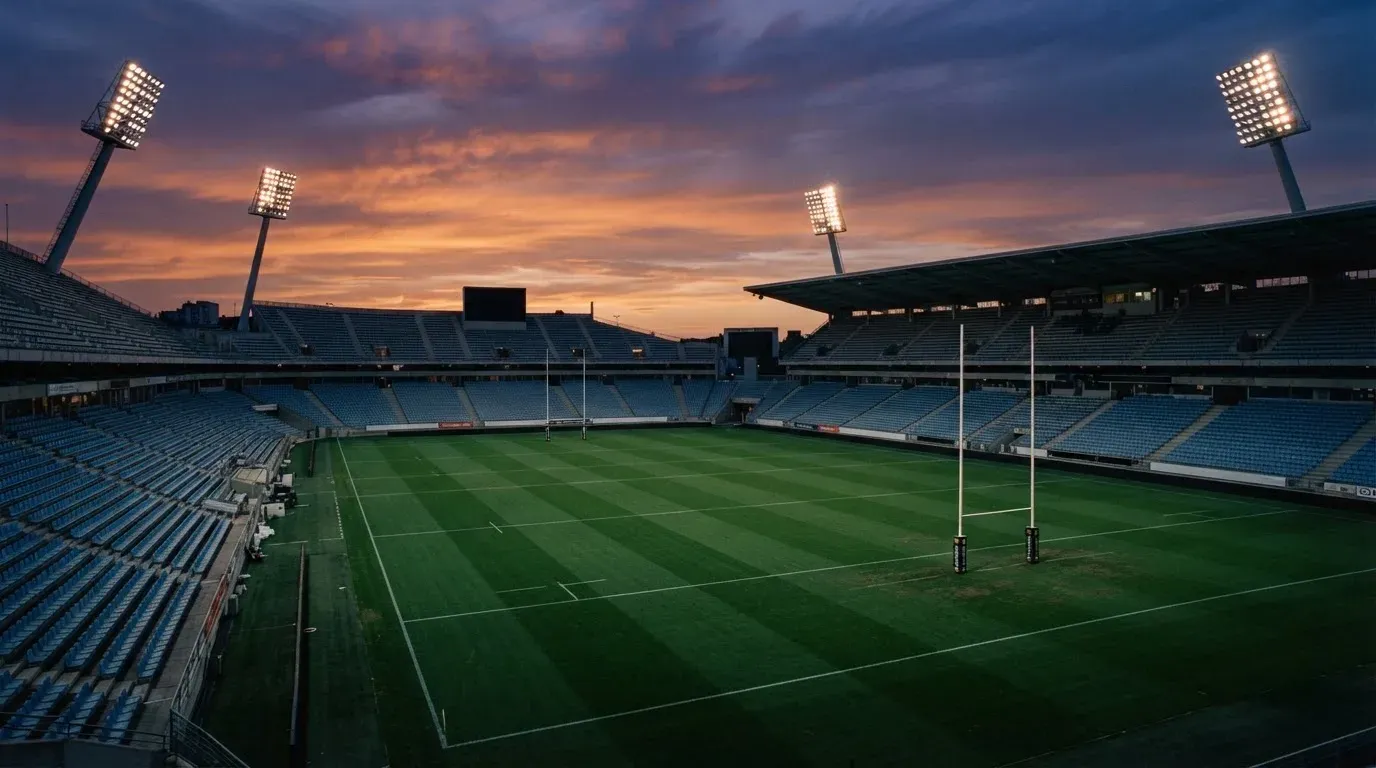
For the punter, the practical consequence is that rugby markets are not football markets. The points move in larger chunks. A 3-0 scoreline through penalties is a real possibility and the under on a total points line can run on late in a game where both sides keep conceding penalties near the posts. The handicap line on a heavy favourite is also wider than in football: a 12-point start in rugby is roughly equivalent to a 1.5-goal Asian handicap in football. Try-scorer markets need the punter to know who is on the field at fullback or in the centres, not just the fly-half.
The first Rugby World Cup was held in 1987 in Australia and New Zealand, and the tournament is held every four years. New Zealand won the inaugural tournament. World Rugby, the governing body of rugby union since 1886, has 116 full member countries and 18 associate members. That depth is what gives the World Cup its outright-winner market: a punter can back any of the tier-one sides (New Zealand, Australia, South Africa, England, Ireland, France, Scotland, Wales, Italy, Argentina) with the knowledge that the field goes several tiers deeper.
The Rugby Championship, an annual Southern Hemisphere tournament, began in 1996 as the Tri-Nations and was renamed in 2012 when Argentina joined. The Six Nations traces its origins to the Home Nations Championship, which began in 1883. Both tournaments carry outright-winner, individual-match and tournament-handicap markets on TAB NZ.
The other piece of the fundamentals a punter needs is the shape of a rugby league match. A rugby league team starts with thirteen players, in two sets of six tackles, with a 40-minute game of two 20-minute halves. Points are scored as a try (4), a conversion (2), a penalty goal (2) and a drop goal (1). The NRL runs from March to early October and is the principal rugby league competition a New Zealand punter bets on, with the Warriors the home side. TAB NZ’s app covers rugby union and rugby league side by side, with the same market catalogue on each.
The legal frame: who may take a New Zealand punter’s money
The Racing Industry Act 2020, as amended by the Racing Industry Amendment Act 2025, is the law. Section 74AAA, in force since 28 June 2025, says no person other than TAB NZ may offer racing betting, sports betting or other racing or sports betting to a person in New Zealand, regardless of where that person is resident or incorporated. The Department of Internal Affairs told providers serving New Zealand to withdraw with immediate effect when the section came into force.
There is no licence route for another bookmaker. There is no register to check a licence on. There is only one lawful operator, and the law puts liability on the offshore operator, not on the player — section 19(4) of the Gambling Act 2003, inserted in 2025, says an individual may not be convicted for placing a bet with an offshore betting operator in breach of section 74AAA. The Department of Internal Affairs warns players of the risks; no published penalty for a player has been found.
The Department of Internal Affairs is the regulator under the Gambling Act 2003 and monitors compliance with the betting prohibition. The Online Casino Gambling Act 2026 licenses online casino gambling only and does not license sports betting; TAB New Zealand winning the right to apply for a casino licence does not extend the betting monopoly. Greyhound racing is closing in stages from 1 August 2026, and from that date offshore operators may not take bets on greyhound races either.
What that means in plain words. TAB and Betcha are the only lawful online betting brands a New Zealand punter can use. They are the same operator, run by Entain under a long-term partnership. Any other bookmaker — whether the punter recognises the brand or not — is operating outside the New Zealand framework when it accepts a New Zealand customer’s bet. The price on the screen may be better; the consumer safeguards are not the same, and there is no New Zealand complaints route if a payout is delayed or refused.
A punt at TAB NZ needs a verified New Zealand address and ID. The age for TAB NZ betting is 18 — that is a different threshold from the land-based casino age of 20, and A punter must not confuse the two. The TAB NZ app carries a 17+ App Store age rating while stating customers must be 18 or over to bet.
Responsible gambling: the tools TAB NZ provides and the help that sits outside
TAB NZ’s safer-gambling tools live in its app: deposit limits, time-outs and self-exclusion. A self-exclusion applies across both TAB NZ brands, so a punter who excludes from TAB is excluded from Betcha as well. The app is published on the New Zealand App Store under the seller name New Zealand Racing Board, first released on 8 September 2014, and the betting age is 18.
The free New Zealand gambling helpline is 0800 654 655, with a text line on 8006. Safer Gambling Aotearoa is the public-facing programme. The Problem Gambling Levy, set at 0.74% from 1 July 2025 to 30 June 2028, funds treatment and harm-minimisation work; it is paid by TAB NZ out of its betting revenue, not by the punter at the betting slip.
For the punter working out a budget, the deposit-limit tool is the practical lever. It caps what can be put into the account over a chosen window — daily, weekly or monthly — and the punter cannot reverse a tightening for a set period. A time-out is a short break. Self-exclusion is the longer lever, and it is the one the helpline will walk a punter through if they call. None of these is a substitute for the punter’s own book on what they can afford to lose, but they sit on the account by default and the punter can tighten them without calling anyone.
There is no single national online-betting exclusion register; the register the casino law will require is for online casinos only. A punter who has excluded from TAB NZ can still open an account with an offshore brand — which is one of the reasons the law targets the operator, not the player.
Live betting and cash out: what the TAB NZ apps actually do in play
The TAB NZ app covers horse and harness racing, rugby union and rugby league and other sports, pre-match and live. The Betcha app runs the same in-play product under the same wallet. Trackside live race streaming with in-app betting sits on the TAB NZ app, along with racing form, Blackbook and Jockey Challenge tools. A simplified wallet handles deposits and withdrawals.
Live rugby betting on TAB NZ means the in-play markets on a Super Rugby Pacific match, a Bledisloe test or an NRL Warriors game: next score, half-time result, total points at the interval, next team to score, try-scorer at any time. The market is smaller than a Premier League football in-play menu — fewer prop markets per match, fewer micro-markets — but the major lines are there and the price updates in seconds.
The statutory position on in-play is settled. The Racing Industry Act 2020 does not ban in-play sports betting; the betting prohibition in section 74AAA is about who may offer, not about which products may be offered. A punter looking for a rugby in-play product at TAB NZ will find one on the major matches. A punter looking for a market on the next play-by-play event in an obscure NRL under-20s fixture will not, and that is an editorial decision on TAB NZ’s side rather than a statutory one.
Cash out on TAB NZ is available on selected markets; the cash-out price updates in real time and the punter can lock in a position before the match ends. The cash-out is offered on TAB NZ’s own terms, with a margin built into the offered price the same way every other market carries a margin. A punter who cashes out at half-time on a six-point lead is taking a price on the remaining 40 minutes, not a refund of the original stake.
Predictions and strategy: the work a rugby punter does before the whistle
The page carries no predictions. No source can tell a punter who will win a rugby match, the Rugby Championship or the 2026 World Cup, and a tip that names a winner is selling certainty that does not exist. The right way to read a “best bets for the World Cup” page is as a record of someone else’s reasoning: the team news, the form, the conditions, the price the tipster took when they wrote the line. The price is the only piece of information a punter can verify afterwards.
Bankroll is the practical lever. A punter who bets 2% of a fixed bank on each play is keeping variance manageable; a punter who bets 10% on a “certainty” is one bad beat from a depleted bank. The All Blacks to win the World Cup is the highest-profile outright market of the cycle and the one a punter is most tempted to over-stake on. The market is large enough that the punter can back New Zealand in parts: take a price at the start of the year, take a tighter price after the squad is named, take a still-tighter one if New Zealand wins the pool. The shape of the betting is itself the bankroll discipline.
The six-nations rugby betting tips market and the equivalents for Super Rugby, the Rugby Championship and the World Cup follow the same pattern: a tip is a price the tipster took with a reason attached, not a guarantee. The punter’s work is the price. If the punter’s own read of the match is the All Blacks by 6 and the market is 4.5, the punter has found a bet. If the punter’s read is 4.5 and the market is 4.5, the punter has found a push. If the punter’s read is 3 and the market is 4.5, the punter has found a market to lay, which is a product TAB NZ does not offer — and that absence is the other practical constraint a New Zealand punter works under.
Forecast work sits in the open data. The All Blacks’ recent results, the team’s record at the venue, the head-to-head, the referee’s penalty count, the weather. The punter builds a read and compares it with the price. Where the two diverge is the bet. Where they do not, the punter passes.
Bet types and odds: what the betting slip actually carries
TAB NZ’s published betting rules define a wide catalogue. Racing has Win, Place, Each Way, Quinella, Exacta, Trifecta, First Four, Double, Treble, Daily Double, Running Double, Quaddie and Big6, plus the same-game multi for sport. Sport has head-to-head, line, total points, half-time / full-time, first try-scorer, any-time try-scorer, margin, and the multi bet — a multi whose legs come from one event, a same-game multi, sits alongside the multi that runs across events.
Decimal odds are the format on TAB NZ. A $10 bet at $2.10 pays back $21 — a $10 stake and $11 of profit. The same bet on a fractional book operates at 11/10. The decimal form makes the math on a multi straightforward: a multi’s price is the product of the legs, so a four-leg multi at 1.50, 2.20, 1.80 and 1.95 returns 11.57. A $10 bet returns $115.70 if all four legs win. One losing leg takes the whole ticket down.
A handicap is a line the punter takes on a side to even the field. A -6.5 handicap on the All Blacks means the All Blacks have to win by 7 or more for the bet to land. A +6.5 handicap on Australia means Australia can lose by 6 or fewer — or win — for the bet to land. The line is set by the bookmaker and the punter’s work is to read whether the line is sharper or softer than the true gap between the two sides.
The bookmaker’s margin is the part of the odds that is not the true reflection of the outcome. It is what the bookmaker keeps, on average, of every dollar bet on the market. The way to see the margin is to invert the decimal odds on every outcome, add them up, and subtract from 1. A 1.90 / 1.90 line gives 1/1.90 + 1/1.90 = 1.0526. The payout share is 1/1.0526, or about 95.0%. The margin is 1 minus that, or about 5.0%. A $100 bet on either side returns $190 if it wins, and across both sides the bookmaker keeps roughly $5 for every $100 bet, on average. A market with a 1.85 / 1.85 line carries a higher margin — about 8.1% — and a 1.95 / 1.95 line a lower one — about 2.5%. The same arithmetic, scaled up, is the way to read any rugby market. A two-way line at 1.90 / 1.90 carries about a 5% margin as a band; the same market priced at 1.85 / 1.85 carries a noticeably heavier one.
The margin matters because it is the cost the punter pays for the convenience of the price. A 5% margin on a $100 bet is $5 of expected loss on the bet, before the punter’s own forecast work. A 8% margin is $8. The line a punter takes on a match is not a market the punter can move; the price the punter pays is. The difference between a 5% and an 8% margin is the difference between a 100-leg season at break-even and a 100-leg season in deficit, all other things equal.
The punter who reads the margin on a market before placing the bet is reading the price the punter is actually paying. A 1.90 / 1.90 line is roughly the standard for a rugby match the bookmaker is confident about. A 1.70 / 2.20 line — heavy favourite, large underdog — carries a higher margin because the price on the favourite is compressed. The same is true of the total-points market: an over / under at 1.90 / 1.90 carries a lower margin than the same line at 1.80 / 1.80.
A multi’s margin is the compounding of the leg margins, so a four-leg multi built on markets with 5% margins carries a compounded margin that is meaningfully higher. The punter who backs four singles at 1.90 instead of one four-leg multi is paying four 5% margins rather than one compounded margin of about 19%. The multi is not free; the multi is a fee for the longer price.
TAB — the racing-led brand of the New Zealand monopoly
TAB is the brand with the longest history and the racing-deepest catalogue. The site carries the Win, Place, Quinella, Exacta, Trifecta, First Four, Double, Treble, Daily Double, Running Double, Quaddie and Big6 products, plus a sports menu that covers rugby union, rugby league, football, basketball, cricket and the major international events. Trackside live race streaming with in-app betting sits on the app, along with form, Blackbook, Jockey Challenge tools and a simplified wallet.
The rugby menu on TAB runs the New Zealand-first product: Super Rugby Pacific, the All Blacks test calendar, NPC, the Ranfurly Shield, the NRL with the Warriors market deep on every Friday night, and the major northern-hemisphere competitions — Six Nations, English Premiership, Top 14. The 2026 World Cup is the headline outright market of the year, with team-by-team and pool-by-pool markets underneath.
For the racing-led punter, TAB is the obvious fit. The tote products, the form, the live streaming and the long-form race cards are the reason the brand has held the retail outlet network for decades. The sports menu is the same as Betcha’s, but the front end is racing-first. The two are the same operator, so a punter who already has a TAB account can use Betcha from the same wallet.
The verdict: TAB is the brand for a New Zealand punter whose betting is a mix of racing and sport, with the racing part heavier. The product catalogue is the widest in the New Zealand market. The price is standard for a New Zealand bookmaker. The safer-gambling tools are the ones the law requires, and they apply across both TAB NZ brands.
Betcha — the sports-led brand of the New Zealand monopoly
Betcha is the same operator as TAB, run by Entain under the long-term partnership, with a sports-first front end. The brand was first released on 6 August 2024. The sports menu is the same as TAB’s — rugby union, rugby league, football, basketball, cricket, MMA/UFC, NBA, NFL, tennis, motorsports and esports — but the front end leads with the in-play product and the multi bet, with racing a click away.
Betcha’s deposit methods, withdrawal times and bonus-bet promotions are TAB NZ’s own terms, applied to a sports-led product. The wallet is shared with TAB. Self-exclusion from one is honoured on the other. The age threshold is 18.
For the sports-led punter, Betcha is the obvious fit. The product is fast, the markets are deep on the major events, and the multi bet is the front-end product the brand was built for. The 2026 World Cup markets on Betcha — outright, pool, individual match, top try-scorer, top points-scorer — are the same as on TAB, but laid out with sport first.
The verdict: Betcha is the brand for a New Zealand punter whose betting is sport-led, with the racing part occasional. The product is mobile-first, the markets are the same as TAB, and the price is standard. The same safer-gambling tools and the same New Zealand framework apply.
Golden Panda — a casino-led brand with a sportsbook, not licensed in New Zealand
Golden Panda is a casino-led brand with a Sports section that includes a sportsbook, esports and virtual sports, alongside casino, live casino, crash games, rewards, cashback, a VIP Club, Golden Goals and Prediction Markets. The brand is published on a Curacao licence and accepts customers from a long list of jurisdictions; the brand names no licence that applies in New Zealand.
The sportsbook menu on Golden Panda is built around football, basketball, tennis and the major American sports, with rugby a smaller line. The brand does not run the New Zealand-first product the All Blacks calendar pulls. A punter who already has a TAB account and a TAB login will not find an All Blacks to win the World Cup outright market at the price a New Zealand bookmaker offers.
For a New Zealand punter, the relevant question is not whether the rugby product is good. It is whether the brand is operating inside the New Zealand framework at all. The answer is no: section 74AAA of the Racing Industry Act 2020 prohibits the offer, and no New Zealand complaints route reaches Golden Panda if a withdrawal is delayed or refused. The Department of Internal Affairs warns players of the risks of overseas operators in jurisdictions with minimal consumer safeguards, and warns that the operator may not return unspent credits or pay out large wins.
The verdict: Golden Panda is a casino-focused site with a secondary sportsbook. It lacks the New Zealand-specific rugby offering, harm-minimisation tools, and complaints framework a local punter needs. Its sports tab does not alter this fundamental gap.
RoyalistPlay — a sports-and-casino brand on a Tobique licence, not licensed in New Zealand
RoyalistPlay’s sportsbook offers live betting, sports promotions, results and a schedule, with football, basketball, tennis, handball, ice hockey, volleyball and table tennis among the top sports, plus separate e-sports and Predictions sections. The brand is published on a Tobique Gaming Commission e-gaming licence (No. 0000002), holder Novatrix SRL, which gives no right to take bets from people in New Zealand.
The rugby menu on RoyalistPlay is built around the major European competitions and the rugby World Cup, with the New Zealand-first product smaller than the European leagues. A New Zealand punter looking for an All Blacks outright market or a Super Rugby Pacific match will find a price, but the price is set against a European customer base and the depth is lower than a New Zealand bookmaker.
Regarding the licensing, our framework applies consistently: section 74AAA of the Racing Industry Act 2020 prohibits the offer by unlicensed operators. As noted previously, the Tobique licence lacks local standing. There are no New Zealand complaints channels, and DIA risks remain.
The verdict: RoyalistPlay combines sports and casino under a Tobique licence. It does not offer the New Zealand-specific protections or regulatory oversight required here. Adding a sportsbook does not mitigate these missing components.
RTbet — a sports-led brand on a Curaçao licence, not licensed in New Zealand
RTbet’s sportsbook covers football, tennis, table tennis, basketball, ice hockey, American football and baseball, with live betting and virtual sports. The brand is published on a Curaçao licence, which gives no right to take bets from people in New Zealand.
The rugby menu on RTbet runs the major European competitions, the Six Nations, and the World Cup outright, with a smaller New Zealand-first product. A New Zealand punter looking for an All Blacks to win the World Cup market or a Super Rugby Pacific match will find a price, but the depth is set against a European customer base.
This operator falls under the same licensing caveat as others listed: it lacks New Zealand authorisation and complaints channels, and the risks outlined by the Department of Internal Affairs apply.
The verdict: RTbet provides a sports-focused experience on a Curaçao licence. It operates outside the New Zealand regulatory system, meaning a local punter lacks the specific protections available locally. Carrying major competitions does not make the operator compliant with New Zealand law.
Glorion — a sports-and-casino brand with no New Zealand-relevant licence
Glorion offers pre-match and live betting, virtual sports, horse racing and esports, with markets grouped into popular, niche, indoor and outdoor sports plus entertainment events such as award shows and elections. The brand names no licence that applies in New Zealand.
The rugby menu on Glorion is built around the major competitions, with the New Zealand-first product smaller than the European leagues. A New Zealand punter looking for an All Blacks outright market will find a price, but the depth is set against a European customer base.
Regarding regulatory status, this operator shares the same lack of New Zealand licence and support channels as those detailed earlier, with DIA risks persisting.
The verdict: Glorion features a diverse betting menu but holds no New Zealand licence. A local punter seeking the safety and complaints framework of the New Zealand market will find these missing. A broad catalogue of sports is not a substitute for regulatory licensing.
Roobet — a crypto-led brand on a Curaçao licence, not licensed in New Zealand
Roobet’s sportsbook covers soccer, basketball, tennis, Counter-Strike, FIFA, baseball, ice hockey, MMA and table tennis, and its terms require players to be 18 or older. The brand is published on a Curaçao licence (OGL/2024/687/0427), holder Raw Entertainment B.V., which gives no right to take bets from people in New Zealand.
The rugby menu on Roobet runs the major competitions and the World Cup outright, with a smaller New Zealand-first product. The brand’s terms set the age at 18, which aligns with the New Zealand threshold, but a New Zealand licence is a separate question from an age threshold.
As discussed, this operator remains outside the New Zealand regulatory framework. It holds no local licence, provides no complaints procedure, and carries the standard warnings regarding offshore risks issued by the Department of Internal Affairs. Accessing the site is at the punter’s own initiative.
The verdict: Roobet, a crypto-centric operator, runs on a Curaçao licence. It serves international markets and does not participate in the New Zealand harm-minimisation or complaints framework. Offering a sportsbook does not bridge this gap.
Alawin — a sports-led brand with no New Zealand-relevant licence
Alawin’s sportsbook covers football, tennis, table tennis, basketball, ice hockey, American football and baseball, with Live Betting, Virtual Sports and esports also offered. The brand names no licence that applies in New Zealand.
The rugby menu on Alawin is built around the major competitions, with a smaller New Zealand-first product.
For a New Zealand punter, the framework question is the same. Section 74AAA prohibits the offer. The brand names no New Zealand-relevant licence. No New Zealand complaints route reaches the brand. The Department of Internal Affairs’s published risks apply.
The verdict: Alawin focuses on sports but lacks a New Zealand licence. It operates entirely outside the local regulatory protections that a New Zealand punter relies upon. The presence of a sportsbook does not make the service a lawful option.
Rooster.bet — a sportsbook-and-predictions brand on a Tobique licence, not licensed in New Zealand
Rooster.bet’s sportsbook has Live, Sports Promotions, Results, Schedule, E-sports and Predictions sections and shows odds in six formats. The brand is published on a Tobique Gaming Commission e-gaming licence (No.
The rugby menu on Rooster.bet runs the major competitions and the World Cup outright, with a smaller New Zealand-first product. The brand’s six odds formats include decimal, which is the format TAB NZ publishes, and a New Zealand punter can read the price without converting.
This operator is also unlicensed in New Zealand. The Department of Internal Affairs does not recognise its credentials, and there are no local routes for dispute resolution or harm-minimisation support for users.
The verdict: Rooster.bet provides sports and predictions under a Tobique licence. It is not licensed to serve New Zealand customers, who thus lose access to local harm-minimisation safeguards and official complaints channels. Providing a sportsbook does not align the brand with New Zealand standards.
BetNinja — a casino-led brand on a Union of the Comoros licence, not licensed in New Zealand
BetNinja advertises a casino welcome of EUR 1,000 bonus and 100 free spins, and a sports offer of a 100% match up to EUR 100 on the first deposit. The brand is published on a licence from the Union of the Comoros, which gives no right to take bets from people in New Zealand.
The rugby menu on BetNinja is built around the major competitions, with a smaller New Zealand-first product.
BetNinja operates outside New Zealand jurisdiction, possessing no local licence or support infrastructure. Users lack access to the official complaints framework, and the Department of Internal Affairs highlights the standard risks associated with such offshore platforms.
The verdict: BetNinja is primarily a casino platform with a sports offering on a Union of the Comoros licence. It offers no regulatory compliance or protection framework for New Zealand residents. Including a sports welcome does not create a lawful New Zealand betting environment.
Worked example: what a 1.90 / 1.90 line actually costs
Take an illustrative two-way rugby market priced at 1.90 / 1.90. A $10 bet on either side pays back $19 — the $10 stake plus $9 of profit. The price is the same on both sides, so the bookmaker is offering a market that looks even.
The arithmetic of the margin is the work the punter does to see what the price is actually costing. The way to read the margin is to invert the decimal odds on every outcome, add them up, and subtract from 1.
1 ÷ 1.90 = 0.5263. Two outcomes at the same price give 0.5263 + 0.5263 = 1.0526. The payout share is 1 ÷ 1.0526, or about 95.0%. The margin is 1 minus the payout share, or about 5.0%.
A $10 bet on either side of a 1.90 / 1.90 line returns $19 if it wins. Across both sides of the market, the bookmaker keeps roughly $5 for every $100 bet — that’s the cost the punter pays, on average, for the convenience of the price. A market with a 1.85 / 1.85 line carries a higher margin — about 8.1% — and a 1.95 / 1.95 line a lower one — about 2.5%. The same arithmetic, scaled up, is the way to read any rugby market. A two-way line at 1.90 / 1.90 carries about a 5% margin as a band; the same market priced at 1.85 / 1.85 carries a noticeably heavier one. The 1.95 / 1.95 line carries a lighter one.
The margin is the cost the punter pays for the convenience of the price. A 5% margin on a $100 bet is $5 of expected loss on the bet, before the punter’s own forecast work. A 8% margin is $8. The line a punter takes on a match is not a market the punter can move; the price the punter pays is. The difference between a 5% and an 8% margin is the difference between a 100-leg season at break-even and a 100-leg season in deficit, all other things equal.
The punter who reads the margin on a market before placing the bet is reading the price the punter is actually paying. A 1.90 / 1.90 line is roughly the standard for a rugby match the bookmaker is confident about. A 1.70 / 2.20 line — heavy favourite, large underdog — carries a higher margin because the price on the favourite is compressed. The same is true of the total-points market: an over / under at 1.90 / 1.90 carries a lower margin than the same line at 1.80 / 1.80.
A multi’s margin is the compounding of the leg margins, so a four-leg multi built on markets with 5% margins carries a compounded margin that is meaningfully higher. The punter who backs four singles at 1.90 instead of one four-leg multi is paying four 5% margins rather than one compounded margin of about 19%. The multi is not free; the multi is a fee for the longer price.
The conclusion: a 1.90 / 1.90 rugby line carries a margin of about 5% — that’s roughly the standard for a market the bookmaker is confident about, and the punter’s expected loss per $100 bet, before the punter’s own forecast work, sits in the same band. The 1.85 / 1.85 line carries a margin of about 8% — a noticeable step up. The 1.95 / 1.95 line carries a margin of about 2.5% — a much lighter price. The punter who reads the margin on a market before placing the bet is reading the price the punter is actually paying, not the price on the screen.
The advertising frame: the rules around promoting a bet
The Advertising Standards Authority’s Gambling Advertising Code applies to betting advertisements. Ads must not target children (under 14) or young people (14 to under 18), judged by context, appeal and expected audience — 25% or more of the audience counts as significant where accurate data exists. Ads must not encourage harm, and must be truthful with terms available. No New Zealand equivalent of a “whistle-to-whistle” ban for betting has been found.
For a New Zealand punter, the practical consequence is that a TAB NZ or Betcha advertisement runs inside the code. The advertisement for an offshore brand runs inside whatever code the offshore jurisdiction has — which is not the ASA code. The punter who sees an offshore advertisement is seeing an advertisement the Department of Internal Affairs reads as promoting an offer the law prohibits.
TAB NZ runs “bonus bets” promotions. No New Zealand rule on bet-bonus size or wagering terms has been found, so the wagering terms are TAB NZ’s own. The punter who takes a TAB NZ bonus bet reads the wagering terms on the promotion page before staking; the punter who takes an offshore bonus bet reads the wagering terms of the offshore brand, which is a different document and a different framework.
Tax: the Inland Revenue position on winnings
For the player, Inland Revenue guidance says recreational gambling winnings are generally not taxable and prize money from TAB horse, dog and trotting races is not taxable. A person who bets as a business is a different case — a punter who books bets at a level Inland Revenue reads as a trade is a different conversation, and the general guidance is to consult Inland Revenue or an accountant.
The operator side is a different frame. TAB NZ pays the Problem Gambling Levy (0.74%). Overseas operators supplying New Zealand residents pay online gambling duty (12% of profits since 1 July 2024, 16% from 1 January 2027), but a duty being payable does not make an offer lawful — a punter must not read a tax line on an offshore operator’s accounts page as a sign the operator is legal in New Zealand. The point-of-consumption charge on offshore racing and sports bets ceased on 30 June 2026.
The punter who has won a $5,000 multi at TAB NZ and is wondering whether to declare it does not need to declare it for tax, on the Inland Revenue guidance as it stands. The punter who is doing the same thing as a business is a different conversation, and the page is not the right place to have it.
The punter’s working set: what the comparison actually shows
| Brand | New Zealand status | What the operator’s own terms say on rugby |
|---|---|---|
| TAB | TAB NZ brand — lawful in New Zealand | Wide rugby menu: Super Rugby Pacific, All Blacks tests, NPC, NRL, Six Nations, English Premiership, Top 14, World Cup outright and match markets; racing-deep tote products; live in-play on major matches. |
| Betcha | TAB NZ brand — lawful in New Zealand | Same rugby menu as TAB, sports-first front end; live in-play on major matches; multi bet is the front-end product. |
| Golden Panda | Not licensed in New Zealand | Sportsbook with rugby, esports and virtual sports; New Zealand-first product smaller than the European leagues. |
| RoyalistPlay | Not licensed in New Zealand | Live betting and sportsbook with rugby among the top sports; New Zealand-first product smaller than the European leagues. |
| RTbet | Not licensed in New Zealand | Sportsbook with rugby among the top sports; live betting; New Zealand-first product smaller than the European leagues. |
| Glorion | Not licensed in New Zealand | Pre-match and live betting with horse racing, esports and entertainment markets; New Zealand-first product smaller than the European leagues. |
| Roobet | Not licensed in New Zealand | Crypto-led brand with sportsbook; rugby is one of the top sports; New Zealand-first product smaller than the European leagues. |
| Alawin | Not licensed in New Zealand | Sportsbook with live betting, virtual sports and esports; New Zealand-first product smaller than the European leagues. |
| Rooster.bet | Not licensed in New Zealand | Sportsbook with live betting, e-sports and predictions; rugby among the top sports; New Zealand-first product smaller than the European leagues. |
| BetNinja | Not licensed in New Zealand | Casino-led brand with a sports offer; rugby among the top sports; New Zealand-first product smaller than the European leagues. |
The two brands at the top are the same operator and the only lawful option. The remaining eight are the brands a New Zealand punter is most likely to encounter in advertising, sponsorship and on comparison sites, and each is plainly outside the New Zealand framework. The column on New Zealand status is the single most important column on the table; the column on the operator’s own terms is descriptive of what the brand does, not of where it sits in the framework.
A New Zealand punter who wants the New Zealand framework, the New Zealand harm-minimisation tools and a New Zealand complaints route is using TAB or Betcha. A New Zealand punter who wants a price or a market the two do not carry is making a different choice, and the page describes that choice so the punter makes it informed.
The work a punter does at the betting slip
A punter at TAB NZ opens the app, signs in, and finds the rugby menu. The 2026 World Cup is the headline outright market of the year. The All Blacks’ price is set at the start of the year, narrows as the squad is named, and tightens further on pool performance. The market is large enough that the punter can back New Zealand in parts.
The punter’s stake is part of a bankroll. A punter who bets 2% of a fixed bank on each play is keeping variance manageable. A punter who backs a multi at $50 of a $200 bank is making one bet, not four. The multi is a fee for the longer price; the fee is the compounded margin of the legs.
A punter at the live market on a Super Rugby Pacific match takes the in-play price. The cash-out is offered on selected markets, with a margin built into the offered price the same way every other market carries a margin. The punter who cashes out at half-time on a six-point lead is taking a price on the remaining 40 minutes, not a refund of the original stake.
A punter who has excluded from TAB NZ and Betcha is excluded across both brands. A punter who has tightened the deposit limit cannot reverse the tightening for a set period. A punter who has set a time-out is on a short break. A punter who needs help calls the Gambling Helpline on 0800 654 655, or texts 8006.
The open data a punter reads
The All Blacks’ recent results are on the World Rugby site, on provincial union sites, and on the All Blacks’ own published media. The team’s record at the venue, the head-to-head, the referee’s penalty count, the weather — all of it is on the public record. The punter builds a read and compares it with the price.
The 2026 World Cup draw is on the public record. The pools are settled. The match schedule is settled. The punter who wants a read on New Zealand’s quarter-final opponent has the data. The punter who wants a read on the All Blacks’ odds to win the tournament has the data; the punter’s read on the data is the punter’s own work.
The Racing Industry Act 2020, the Racing Industry Amendment Act 2025, the Gambling Act 2003, the Online Casino Gambling Act 2026 and the Department of Internal Affairs’s published statements are on the public record. The punter who wants a read on the law has the data. The punter who wants a read on which brands are operating inside the framework has the data.
The help that sits outside the betting slip
The free Gambling Helpline is 0800 654 655, with a text line on 8006. Safer Gambling Aotearoa is the public-facing programme. The Problem Gambling Levy funds treatment and harm-minimisation work. None of this is a substitute for the punter’s own book on what they can afford to lose, but it sits on the public record, and the punter who needs it knows where to find it.
A punter who is gambling more than they can afford is a punter who needs to call the helpline, not a punter who needs another betting tip. A punter who is chasing losses is a punter who needs the helpline, not a punter who needs a higher stake. The punter who keeps the betting to a level they can afford to lose is a punter who is using the product the way it is meant to be used.
The verdict on the page
The page works through the rugby calendar, the law, the safer-gambling tools, the live product, the predictions frame, the bet types, the odds, the ten brands and the worked margin. The two lawful brands are TAB and Betcha, the same operator, the only path inside the New Zealand framework. The remaining eight brands are the names a New Zealand punter is most likely to encounter, and each is plainly outside the framework.
The punter who wants the New Zealand framework, the New Zealand harm-minimisation tools and a New Zealand complaints route uses TAB or Betcha. The punter who wants a price or a market the two do not carry is making a different choice, and the page describes that choice so the punter makes it informed.
The work the punter does before the whistle is the work the punter does after the bookmaker has set the price. The price is what the punter pays. The forecast is what the punter reads. The margin is what the punter keeps an eye on. The bankroll is what the punter does not bet. The help is what the punter calls when the help is needed.
Frequently asked questions
How does rugby handicap betting work?
A handicap is a line the punter takes on a side to even the field. A -6.5 handicap on the All Blacks means the All Blacks have to win by 7 or more for the bet to land. A +6.5 handicap on Australia means Australia can lose by 6 or fewer, or win, for the bet to land. The line is set by the bookmaker, and the punter’s work is to read whether the line is sharper or softer than the true gap between the two sides.
How to bet on rugby games?
A New Zealand punter opens a TAB or Betcha account (the same wallet across both), verifies a New Zealand address and ID, sets a deposit limit, and finds the rugby menu under Super Rugby Pacific, the All Blacks test calendar, the NRL or the World Cup. The punter picks a market, takes a price, places a stake. The decimal odds on the slip show the return. The punter who wins sees the payout in the wallet. The punter who loses does not see it, and the deposit limit is the backstop.
What are the betting odds on 2026 rugby world cup?
The outright market on the 2026 Rugby World Cup runs for twelve months before kickoff and the prices move with team news. The All Blacks are among the favourites and the price is set against the field of tier-one sides. The bookmaker’s margin on the outright market is built into the price, and a 1.90 / 1.90 line on a heavy favourite carries about a 5% margin; a 1.85 / 1.85 line carries about 8%; a 1.95 / 1.95 line carries about 2.5%. The price a punter pays is the price on the screen, less the margin.
Which bookmaker may lawfully take sports and racing bets in New Zealand?
TAB and Betcha, the two online brands of TAB NZ, are the only operators that may lawfully offer racing and sports betting to a person in New Zealand. The Racing Industry Act 2020, section 74AAA, in force since 28 June 2025, prohibits the offer by anyone else, regardless of where that person is resident or incorporated. The Department of Internal Affairs told unlicensed providers to withdraw with immediate effect when the section came into force.
How is the return on a bet worked out from the stake and the odds?
Decimal odds are the format on TAB NZ. A $10 bet at $2.10 pays back $21 — the $10 stake plus $11 of profit. A multi’s price is the product of the leg prices, so a four-leg multi at 1.50, 2.20, 1.80 and 1.95 returns 11.57. A $10 bet returns $115.70 if all four legs win. One losing leg takes the whole ticket down. The formula: return = stake × odds. Net profit = stake × (odds − 1).
What is the bookmaker’s margin and how can it be seen in the odds?
The margin is what the bookmaker keeps, on average, of every dollar bet on the market. The way to see it is to invert the decimal odds on every outcome, add them up, and subtract from 1. A 1.90 / 1.90 line gives 1 ÷ 1.90 + 1 ÷ 1.90 = 1.0526, a payout share of about 95.0% and a margin of about 5.0%. A 1.85 / 1.85 line carries a margin of about 8.1%; a 1.95 / 1.95 line carries about 2.5%. The margin is the cost the punter pays for the convenience of the price.
Rugby, league & cricket – kiwiracingbets
Content created by the «kiwiracingbets» team
